


There are some things you can always count on in life: The sun rising and setting, the tide advancing and retreating, and UK police announcing new investigations of social media posts.
This time, it’s over an Instagram post from London Assembly member and Green Party leader Zack Polanski, who initially accepted a collaboration request on an Instagram carousel of images from a recent Green Party event. Polanski was tagged as a co-author on the post by another account and approved the tag, bringing the post onto his account and into his followers’ newsfeeds.
What was in the post? How did police respond?
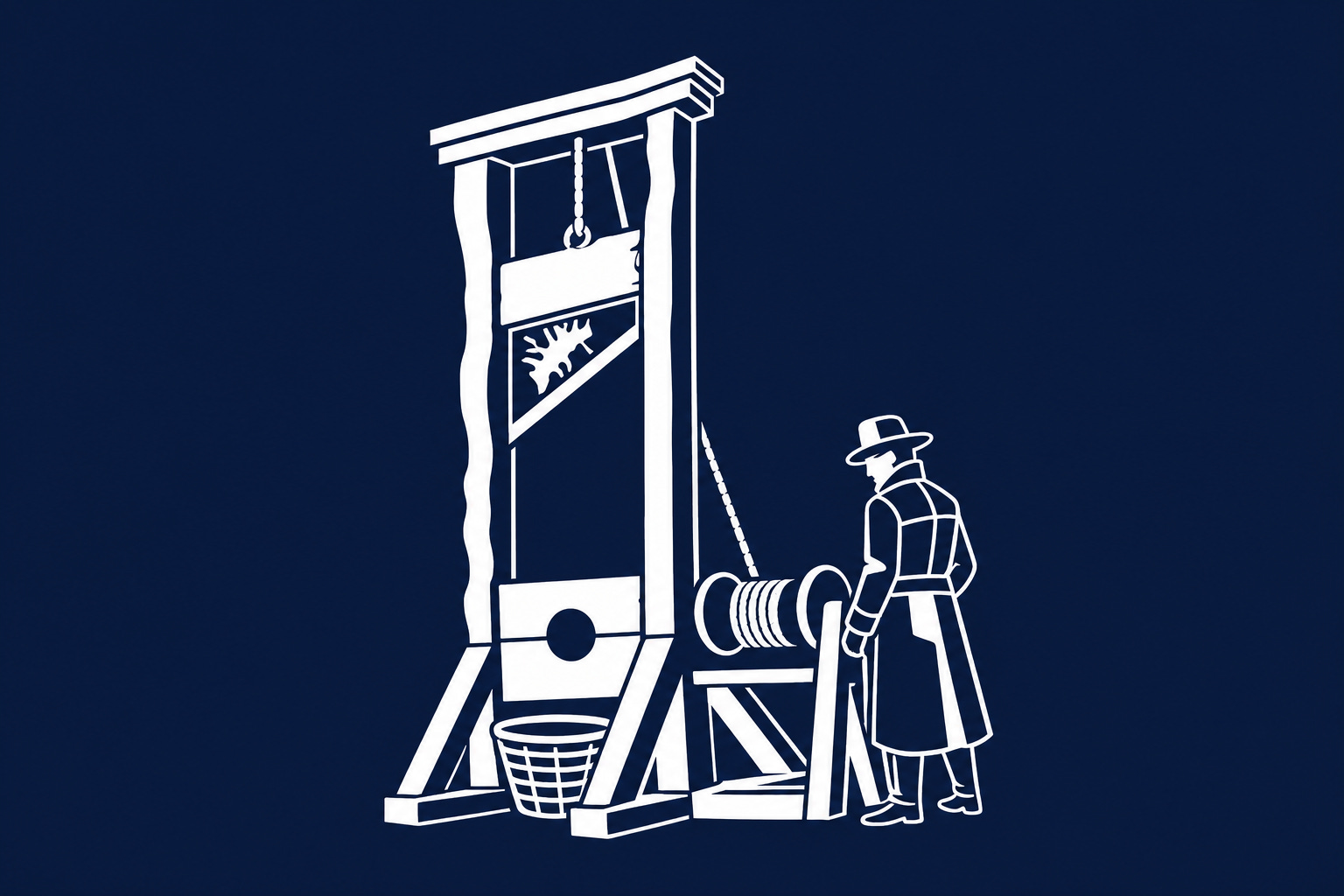
The fifth image in the carousel showed a man at the event wearing a T-shirt depicting artwork of a person operating a guillotine and the text “We’re only making plans for Nigel.” The BBC reports that the words on the shirt “are the same as the lyrics of a 1979 song by band XTC.” A party spokesman said of Polanski’s post, “Once this image was brought to his attention he immediately unshared the post. He unequivocally does not support this type of dangerous message.”
The UK’s Reform Party, and its leader Nigel Farage, made the case that the shirt is referencing Farage — and they’ve asked police to intervene. Reform Spokesperson for Home Affairs Zia Yusuf, who argued the image shows “the beheading of Nigel Farage,” said: “This is incitement to murder. It should be treated as such by the police.” He also wrote earlier this week, “If Zack Polanski is not in police custody by this time tomorrow, the Police will have declared open season on Members of Parliament.”
Farage, too, weighed in calling for arrest: “If I was to post anything as inciteful then I would expect to be arrested, and so should Polanski.”
The man who wants back into San Quentin

In order to teach, Bill Smoot had to leave everything behind. His wallet, cash, credit cards, and chewing gum — everything but his car keys, ID, and course materials.
In a statement, Metropolitan Police confirmed they’re looking into it: “Earlier today we received a third-party report relating to an image shared on social media. We take reports of this nature extremely seriously, and officers are conducting inquiries into the matter.”
It’s not clear, though, whether police are looking into Polanski, the Instagram account that originally uploaded the photo, the man pictured wearing the shirt, or some combination of those involved. A freelance photojournalist who took and uploaded the photo said Polanski was not responsible for the image, and that he had reported himself to police to explain the context.
The UK’s uneasy political environment
Tensions around charged political expression are particularly high in the UK right now, given the recent gruesome murder of Ann Widdecombe, a politician and member of the Conservative, Brexit, and Reform Parties over her career. Widdecombe was found in her home earlier this month, bludgeoned to death with a hammer. Prosecutors have since charged a 28-year-old man with murder and terror offenses, and police are still investigating the suspect’s motives.
Politicians and commentators like Reform’s Zia Yusuf have connected the two cases, arguing that the guillotine image is particularly dangerous “just two weeks after our friend Ann was murdered.”
It’s not the only free speech question that has arisen in the aftermath of Widdecombe’s murder. Despite originally saying her posts were not criminal, police arrested University of Aberdeen web developer Heather Herbert for Bluesky posts celebrating Widdecombe’s death. “And some good news for once. I hope it was an extremely painful death. And I hope she was handcuffed to the bed as she screamed in agony,” Herbert wrote in a post. And in response to a critic of her comment, she said: “I’m done with being nice to pieces of human garbage like her.”
What does this mean for free speech?
Both these posts — the image of the guillotine and the comments celebrating Widdecombe’s murder — would be protected in the U.S., and the First Amendment has answered these questions before, some quite recently. They remain deeply contentious socially, though.
On the question of the first, the guillotine shirt that says “We’re only making plans for Nigel,” the Supreme Court’s definitive cases addressing true threats and incitement are instructive.
In Watts v. United States (1969), the case centered on an 18-year-old who said at a Vietnam War protest, “If they ever make me carry a rifle the first man I want to get in my sights is LBJ . . . They are not going to make me kill my black brothers.” The Court, finding that Watts’ speech was protected political hyperbole, explained that advocacy in the political arena “is often vituperative, abusive, and inexact.” True threats require that the speaker convey a serious intent to commit violence, not just engage in rough and tumble expression around politics.
Similarly, the Court’s reasoning in Brandenburg v. Ohio (1969), a First Amendment challenge to a Ku Klux Klan leader’s conviction under an Ohio criminal syndicalism law, lays out its approach to incitement to imminent lawless action. The Court ruled that simply advocating or celebrating violence is protected as long as it’s not intended and likely to provoke immediate unlawful action.
Without more, this T-shirt, whether a reference to Farage is intended or not, would not meet the high bar required for either the true threat or incitement tests in the U.S. — not for Polanski, the person who posted the image, nor the man who wore the shirt.
And regarding the legality of posts commenting on a political figure’s death, the United States is still dealing with the fallout of censorship after the murder of Charlie Kirk last fall, but it’s not a crime to speak ill of the dead. And for good reason. Guidelines around how we discuss the dead are matters we must map out socially, not legally.
Government bodies, including public universities that fired faculty members who posted controversial or critical tweets about Kirk after his killing, are now paying out steep settlements to those same faculty members who sued and raised First Amendment claims. FIRE has also brought two First Amendment lawsuits over protected speech about Kirk, both in Tennessee. FIRE recently secured an $835,000 settlement for retired law enforcement officer Larry Bushart, who was jailed for 37 days after posting a meme on Facebook that quoted President Trump saying, “We have to get over it.” And FIRE’s case on behalf of an Iraq War veteran, fired by a state agency for criticizing Kirk in a Facebook comment, is still ongoing.
Why student journalists are asking to remove their names from articles

Last summer, a former student journalist asked the University of Michigan’s student paper The Michigan Daily to take down or anonymize an article they had written more than 10 years ago. The article mentioned their involvement in a movement calling for the school to divest from companies associated with the Israeli government. In the email, …
But ultimately we’re talking about the censorship battles taking place in the UK, where there is certainly no First Amendment or neutral speech principles to be found. And that’s exactly the problem. The UK has created a turnkey censorship system so expansive and reflexive that officers are encouraged to act as speech police in part because they already have done so, thousands and thousands of times.
Farage said he believes he would be investigated over a similar post, so he wanted to see Polanski receive the speech police treatment. The solution, however, is not a race to the bottom, where police are asked and expected to run a magnifying glass over every X, TikTok, and Instagram post. All that will do is further entrench an already disturbing practice granting officials the power to narrow the boundaries of expression. Indeed, in testimony before the U.S. House Judiciary Committee last year, Farage lamented that on “the question of civil liberties, Britain has, unfortunately, now lost her way,” and rightly advocated First Amendment-style protections in the UK.
After dropping the case over comedian Graham Linehan’s tweets last year, Metropolitan Police admitted that officers should not be “policing toxic culture war debates” and that the agency must move away from investigating non-criminal online speech. That’s right. The UK needs to turn away from speech police and toward speech protections. You can’t fix a free speech problem by digging deeper into censorship.

So if you had a t-shirt with Jesus on the cross , would this be seen as an inducement to kill Christians?