


East Dallas in the 90s was riddled with crime and turf wars. Growing up there, Victor Quiñonez found solace in his art. He was only four the first time his father, a day laborer, got deported back to Mexico. It happened several times during his childhood, so immigration law became a theme in his family life — and later, in his art.
It turns out that he was good at art, too. His talents got him into Booker T. Washington High School for the Performing and Visual Arts. Then he got a full-ride scholarship to the School of the Museum of Fine Arts at Tufts University. Now, he’s a celebrated artist, going by the tag “Marka27,” and exhibits his work across the country.
This past February, Quiñonez had a scheduled installation titled Ni de Aquí, Ni de Allá (Not From Here, Not From There) at the University of North Texas. The exhibit features giant resin paletas (Mexican popsicles) with seals that read “U.S. Department of Stolen Land Security” and “U.S. Inhumane and Cruelty Enforcement.”
California lawmakers threaten free speech regarding immigration groups

A new bill under consideration in California is facing criticism for censoring speech about immigration. Elon Musk has claimed the bill would “make investigating fraud illegal.” One opponent has dubbed it the “Stop Nick Shirley Act,” named after the YouTuber know…
But fearing political repercussions, UNT Dean Karen Hutzel canceled the exhibition. Worse, under the cloak of night, school officials later removed student sidewalk chalk messages, posters, and other materials protesting the exhibit’s cancellation. While school administrators can regulate the time, place, and manner of such protests on campus, they must do so in a viewpoint-neutral way — and all the available information suggests that the school specifically singled out these protest messages for erasure.
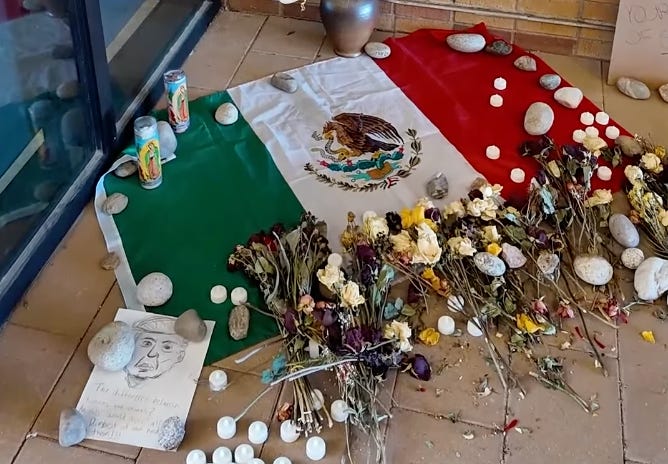
The student group NOISE claims its messages, art, and flowers in honor of the exhibit were “violently taken and ripped apart in the dark of the night” at the direction of school officials. The staff who were responsible for the removal said they were told to do so by school lawyers — and that it was not part of their regular job duties.
UNT has the right to clear protest materials that obstruct walkways or prevent other normal uses of its space. But chalk and posters generally don’t do that, and the off-hours power-washing suggests the school might not be cleaning up campus so much as silencing its critics.
The Supreme Court has been extremely clear about such efforts. It has ruled that targeting expression based on its viewpoint is an “egregious form of content discrimination,” adding that government actors (including public universities) must “abstain from regulating speech when the specific motivating ideology or the opinion or perspective of the speaker” motivates the restriction. In addition, the Court said, when regulations or authorities target “particular views taken by speakers,” the violation “is all the more blatant.”
Is that what happened here? Consider: UNT policy explicitly says “chalking on University sidewalks is permissible.” And while the school does prohibit chalking on vertical structures like walls and covered areas such as atriums, video footage shows that at least some of the chalking removed at the behest of administrators was on university sidewalk space outside the College of Visual Arts & Design building, where school policy explicitly allows chalking. Even when it comes to chalking in restricted areas, staff comments suggest the school normally just lets the elements wash the messages away.
As happens so often in censorship cases, UNT’s attempts to silence dissent have only fanned the flames. The National Coalition Against Censorship and the ACLU of Texas rightly called out the school with a not-so-subtle mobile billboard truck earlier this month. Around the same time, the Dallas Observer ran the story, “An Act of Censorship Leaves UNT Facing an Identity Crisis.”
Free Speech Future: Episode II – Regulating AI: Who decides?

In case you missed it, remember to also check out the first episode in this series, which covers AI and knowledge creation.
Texas is censoring its faculty at industrial scale. And it’s ground zero for America’s latest crisis in artistic freedom. The Lone Star State saw a police raid seize art off the walls from a museum last year, recalling the hysteria of the Mapplethorpe persecutions from the 1980s. But the students at UNT who staged a protest funeral for artistic freedom in Dallas this spring aren’t going to let freedom of expression die in Texas. UNT graduating arts students are protesting the school’s art censorship by boycotting the traditional on-campus “Senior Exit Show” this April in favor of an off-campus alternative. Their protest chalkings were clearly protected by the First Amendment, too.
Among the messages posted by students were “SILENCING IS POLICY” and “STOP SILENCING STUDENTS YOU ARE MEANT TO PROTECT.” UNT’s lack of self-awareness in silencing such messages is stunning.
UNT is a public university, and following the First Amendment is not optional. It must stop targeting student criticisms for erasure. On March 4, FIRE wrote to UNT regarding its decision to shutter Quiñonez’s art exhibition and its threats of possible future censorship of faculty and students whose expression falls outside the university’s comfort zone. Now, just one month later, it appears some of those threats — namely silencing student expression on themes related to the canceled exhibition — have materialized. UNT must cease its war on free expression on campus and recommit to the First Amendment — because the First Amendment means nothing if administrators can make disfavored speech disappear overnight.
