


Last week, Jeff Dean, Google’s chief scientist and the lead for Gemini AI, came to the University of California at Berkeley to discuss modern AI research. He was not there to debate the war in Gaza, defend Google’s government contracts, or make a campaign speech. He was there for a scientific lecture.
But as a May Day rally on campus ended about an hour before Dean’s scheduled appearance, one student organizer told the remaining crowd that a speaker from Google’s Gemini AI was about to appear nearby and encouraged them to help him disrupt the event.
At 1:37 p.m., protesters entered the Grimes Engineering Center. Most of them chanted, “UC, UC, you can’t hide, you are funding genocide.” At least one walked onto the stage with a megaphone and asked Dean, “What do you say for your AI being used to kill Palestinians?” Dean replied that he was there to deliver a “scientific lecture.”
At 1:47 p.m., event organizers announced that the event would be shut down.
What do the most and least tolerant students say about self-censorship?

The battle for free speech on American campuses isn’t just a string of legal skirmishes to protect students and faculty from backlash when they speak their minds. It also means creating a climate in which they feel comfortable speaking up in the first place. That’s why this week, we decided to look into the data behind student self-censorship.
This episode is not an outlier, but part of a pattern that is accelerating. Since noting a little over a month ago that we are on pace for a record number of deplatforming attempts this year, we’ve recorded another 38. That increases this year’s tally to 108, over a span of basically four months. That’s already the fifth-highest total for a year in the entire database, which begins in 1998. And even though the success rate of these attempts declined from the staggering 93% we previously reported, it remains incredibly high at 72% (78 successful attempts).
By “deplatforming attempt,” we mean an effort to prevent a speaker, performer, artwork, or event from being heard or seen, whether through disruption, disinvitation demands, administrative cancellation, or pressure that leads a speaker to withdraw.
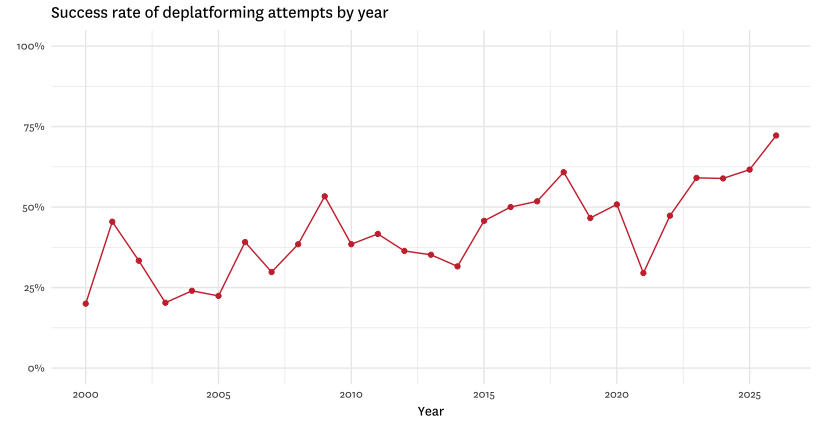
To be clear, protest is not the problem. Students have every right to picket, criticize, ask hard questions, and condemn speakers they find objectionable. The line is crossed when protest becomes a veto, when the goal is not to answer speech with more speech, but to ensure no one else can hear it, and incidents of that nature are becoming rampant. Indeed, the following ones all occurred over the past month:
Administrators at Cape Fear Community College required the removal of a “No Kings” protest sign from the set of an opening-night student performance of the play The Bacchae due to political concerns.
Noa Cochva, a former IDF combat medic and Miss Israel 2021, withdrew from speaking at the University of Oregon due to safety concerns after a large protest gathered at the reserved outdoor space. and organizers said protesters were blocking access and disrupting the event area. Cochva also had an invitation to speak at the University of Washington revoked due to safety concerns.
Conservative political commentator and media host Stephen Crowder withdrew from a debate at the University of Pennsylvania with professor Jonathan Zimmerman, because the university refused to allow the debate to be livestreamed due to “safety concerns.”
Students at the University of California in Los Angeles repeatedly attempted to disrupt a discussion between James Percival, the Department of Homeland Security’s general counsel, and Gregory McNeal, a Pepperdine law professor, by shouting questions, booing, holding signs with anti-ICE messages, playing sound effects, and making additional noise after the panelists were introduced.
Pamela Evette, South Carolina’s lieutenant governor, had her invitation to deliver the commencement address at South Carolina State University revoked after a student-led petition demanding Evette’s disinvitation because of her political views garnered almost 9,000 signatures.
Rutgers University revoked an invitation to alumnus Rami Elghandour, CEO of Arcellx, to deliver a commencement address after students objected to his social-media posts accusing Israel of war crimes and apartheid.
Multiple attempts to disrupt the “Triggered: From Combat to Campus” tour — featuring Israeli Defense Force soldiers and/or reservists — on campuses across the country.
So, for those keeping score, that’s 108 deplatforming attempts in 17 weeks so far this year. Or basically one every day. These attempts are happening everywhere — at prestigious institutions like UPenn, UCLA, and UC Berkeley, and at lesser known schools like South Carolina State University, Western Washington University, and Cape Fear Community College.
The pace and volume of these attempts is breathtaking. If current trends hold, we can expect roughly 330 deplatforming attempts this year, which would shatter 2024’s record of 180. And, while that 330 figure probably won’t be reached, this year is still already the fifth-highest ever for these attempts and it’s only May 7.
This is alarming. Colleges do not have to invite every speaker. But once they do, they have an obligation to make sure the event can proceed. Students may protest, condemn, and challenge. They should not be allowed to veto. If campuses cannot maintain that distinction, the record being set this year will not just be a statistical milestone. It will be a warning about what higher education is teaching students to do with disagreement.

We need to call out all The Brown Shirts no matter what flavor they come in. "Protesters" is a misnomer and gives them a credibility they do not deserve.
It seems easily soluble. Disrupt an event, get kicked out.