


The Catholic Church is a pedophilic institution. The police are just as racist as the Ku Klux Klan. Children should be able to transition without parental consent.
Should a college permit speakers who have made those statements to appear on campus? FIRE asks students that question to measure their tolerance for speakers associated with the political left. Then we give them three more statements:
Transgender people have a mental disorder. Abortion should be completely illegal. Black Lives Matter is a hate group.
Those statements measure tolerance for speakers associated with the political right.
The results reveal a disturbing trend. The ideological tolerance gap on campus is shrinking, but not because students are becoming more open-minded. Rather, it appears they are becoming less tolerant across the board.
Speaker tolerance matters because it’s foundational to a university’s purpose. A central premise of higher education is that students will encounter a range of ideas, including ideas that conflict with their deepest convictions. By confronting unfamiliar, offensive, or even repugnant arguments, students must test their assumptions, sharpen their reasoning, and learn to defend or revise their beliefs.
If students are never challenged by being exposed to offensive views, higher education becomes an exercise in affirmation rather than inquiry.
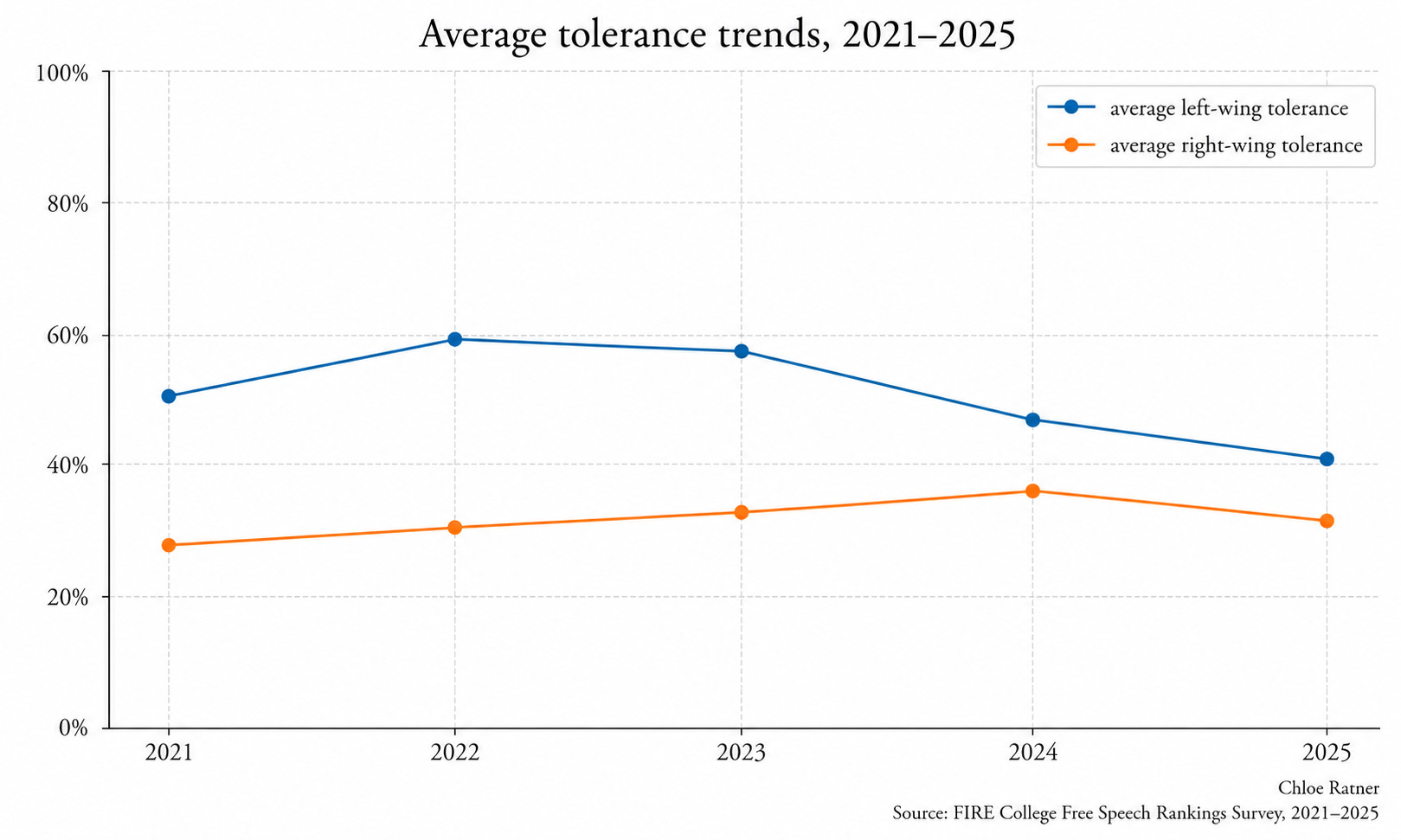
Five years of data from FIRE’s College Free Speech Rankings Survey show that the gap between tolerance for left- and right-wing speakers has narrowed substantially — from about 23 percentage points in 2021 to roughly eight in 2025.
At first glance, that might look encouraging. Perhaps students are moving toward a shared commitment to hearing both sides.
They aren’t.
Tolerance for right-wing speakers has remained consistently low, generally ranging from the high 20s to the high 30s. Tolerance for left-wing speakers, meanwhile, peaked at about 60% in 2022 before falling to roughly 41% in 2025.
The questions used to measure tolerance for left-wing speakers changed between the 2023 and 2024 rankings. That limits direct comparisons across the full period and means additional years of data will be needed to determine the size and durability of the decline.
Even with that caveat, the most recent result is troubling. A 41% tolerance rate is difficult to dismiss as a product of questionnaire changes alone, particularly when the broader measure of speaker tolerance is also falling.
The gap did not close because tolerance rose on both sides. The available evidence instead suggests that support for left-wing speakers fell toward an already low level of support for right-wing speakers.
Campus tolerance for free speech is tanking

Editor’s note: On Sept. 10, conservative pundit Charlie Kirk was assassinated on the campus of Utah Valley University. FIRE Executive Vice President Nico Perrino wrote about it here.
That decline is enough to pull down the overall average. Combined tolerance for left- and right-wing speakers peaked at roughly 46% to 47% in 2022 and 2023. It has fallen since then, reaching about 37% in 2025 — the lowest level in the five years examined.
Students are not converging around greater openness. They are converging around a greater willingness to keep controversial speakers off campus.
Party identification reveals a predictable pattern: Strong partisans on both sides are less tolerant of speakers associated with the opposing side.
But the size of that intolerance is not symmetrical.
Year after year, the strongest Republicans in the survey reported tolerance for opposing speakers that was roughly 10 to 15 percentage points higher than the tolerance the strongest Democrats reported for speakers on the right. Independents and students who only leaned left or right came closest to showing equal tolerance for both groups.
A drop in tolerance for right-wing speakers alone would fit the familiar story that conservative speakers face especially hostile audiences on many campuses, especially with majority left-leaning faculty. But falling tolerance for left-wing speakers points to a broader problem: Students may be losing interest in hearing controversial speakers at all.
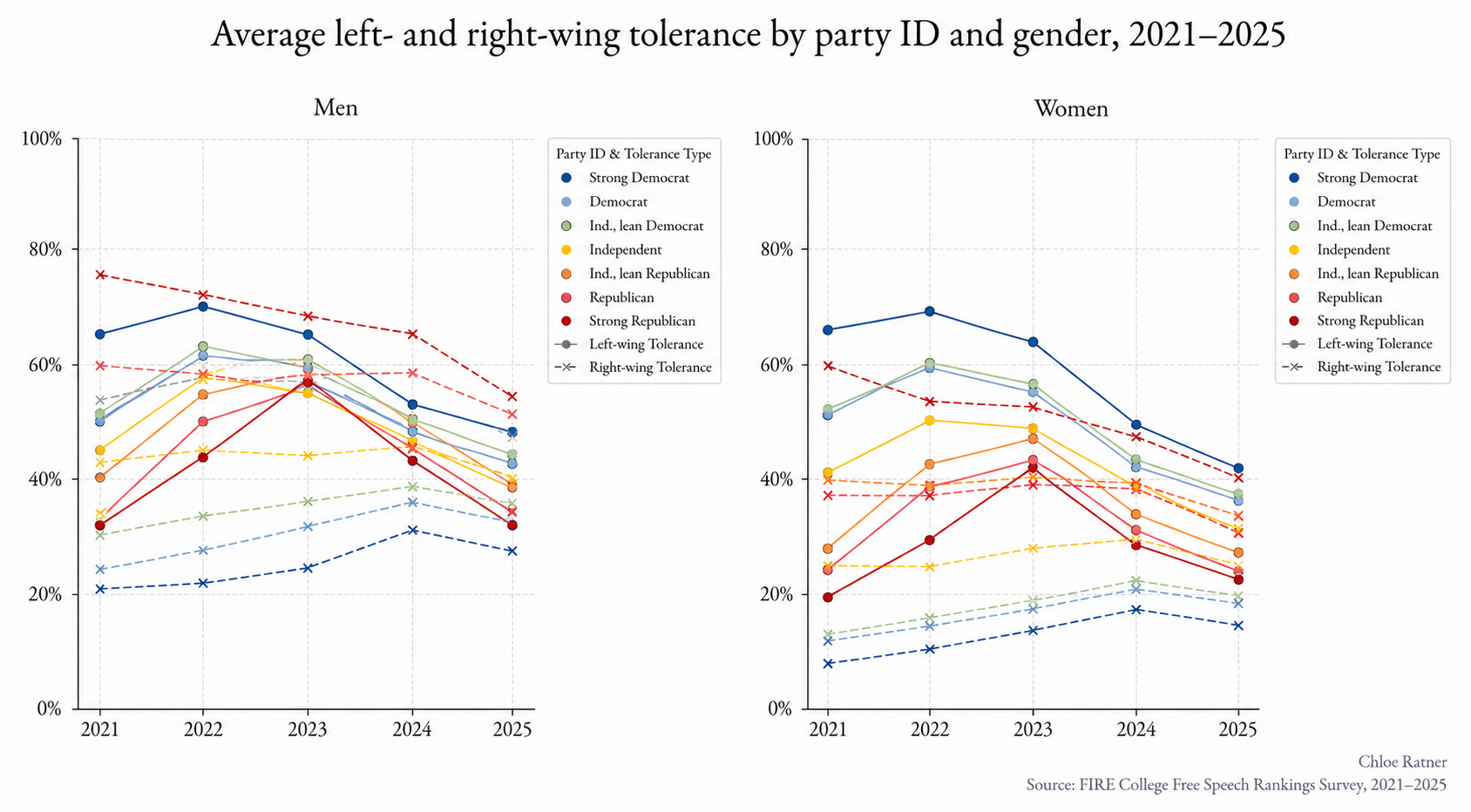
Gender adds another layer. With few exceptions, women in every partisan group reported less tolerance than men for both left- and right-wing speakers. The gap was not enormous, but it was persistent across political identities and survey years. The data do not establish why that gender gap exists. But its consistency suggests it cannot easily be attributed to one party, one controversy, or one political moment.

Taken together, these findings offer little evidence that polarization is receding. Students remain more accepting of speakers who share their politics, while overall tolerance for controversial speakers appears to be declining.
For colleges that claim to foster serious debate and critical inquiry, that should set off alarms. Administrators and faculty members cannot force students to admire an invited speaker or sit silently through a bad idea. They can, however, teach students that allowing a speaker to appear is not an endorsement. It is an invitation to listen, think, question, or even protest (non-disruptively).
A university should prepare students to answer ideas they hate, not teach them that the presence of those ideas is itself intolerable.

On the topic of discourse, fantastic. But i always put myself in these shoes. Left out are the wider population there to get a degree, form a professional network, and move on in life. My scholarship and bills did not afford me such luxury and dalliance as “campus activism.” i had a job. I had an LSAT to prepare for. Protest and clubs were for the children being sent by mom and dad.