“Yale’s data suggests that self-censorship is a real problem. In a 2025 survey by the university, nearly a third of undergraduate respondents disagreed with the statement that ‘I feel free to express my political beliefs on campus,’ up from 17 percent in 2015.”
—Yale Committee Report on Trust in Higher Education, April 10, 2026, also see Graham Piro’s essay on the report and this week’s data dive on student self-censorship.
DOJ indicts Comey, again
The Department of Justice indicted former FBI Director James Comey for allegedly threatening to murder President Trump by posting an image online of seashells on the beach in the shape of the numbers 8647, which critics interpret to mean “eliminate the 47th president.”
As Angel Eduardo and Aaron Terr recently wrote for Persuasion:
The reality is that this indictment is a flimsy excuse to use government authority to punish the president’s political enemies — something this administration is quite fond of and has been thoroughly documented doing. This is all the more reason to vehemently oppose this indictment and the retaliatory actions of the administration.
If political retribution for speaking out becomes the norm in American politics, then everyone’s right to free speech could be eighty-sixed.
Below the fold
“Elon Musk’s personal political views have no place in the California Coastal Commission’s evaluation of SpaceX’s rocket launch proposals,” Aaron Terr wrote on X, responding to California regulators settling a SpaceX lawsuit this week.
A New York bill would prevent AI chatbots from giving legal, medical, financial, mental health, or other advice normally provided by a licensed professional.
A lawsuit against Black Lives Matter activist DeRay McKesson, despite no evidence he committed or incited violence, has survived federal appeals court review, meaning protest organizers nationwide could face massive financial liability for unforeseeable acts by others.
California lawmakers are considering making “anti-hate” training a requirement.
This week in history
In April 1989, the former head of the Chinese Communist Party died. Hu Yaobang had pushed for democratic reforms, and when students gathered to mourn him, they began to demand freedom of speech and democratic reforms themselves. Up to 100,000 students marched across the city into Tiananmen Square. As protests continued throughout May, Beijing declared martial law. On June 4, the military forcibly cleared the square, killing up to 2,000 people. The CCP removed officials who had supported reform — or opposed the massacre, discussion of which remains heavily censored in China today. Chinese sometimes use “8964” (1989, June 4) as a coded reference online to bypass censors, but even this gets picked up nowadays.
By the numbers
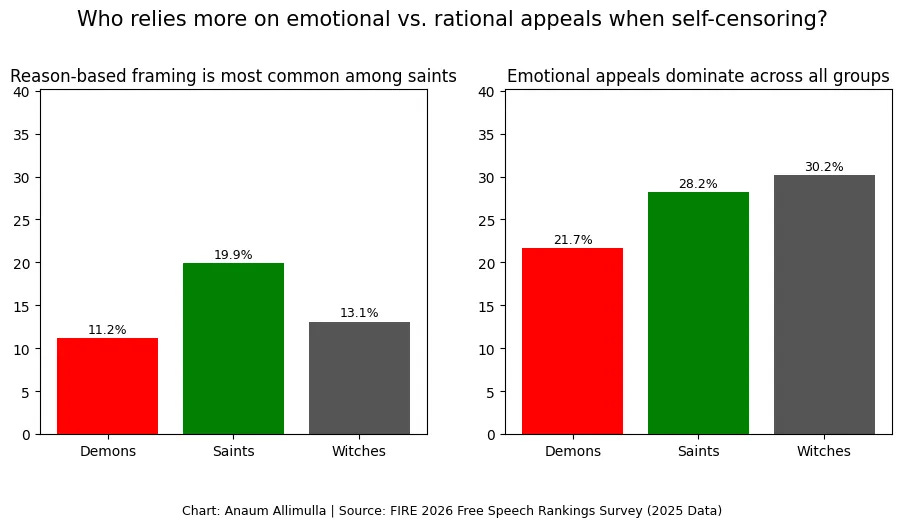
This week, we looked into the data behind student self-censorship. Among other things, we found that students tend to lean heavily on emotional rather than rational thinking when deciding to censor themselves. In fact, even the most principled group operates less on principle than on how situations feel.