


Douglass Mackey and Don Lemon likely agree on almost nothing.
Mackey is the pseudonymous pro-Trump provocateur who, as “Ricky Vaughn,” built a large Twitter following during the 2016 campaign, including with two false vote-by-text memes that eventually made him (briefly, until an appeals court threw out the conviction) a felon: images telling Hillary Clinton’s supporters they could skip the polls and vote by text.
Lemon is the longtime CNN anchor, who left the network in 2023 and turned up at a St. Paul church this past January with a camera running and as anti-ICE protesters disrupted a Sunday service.
Their politics, their audiences, and their sensibilities run in opposite directions.
What they share is a charge. Both were charged under 18 U.S.C. § 241, the federal conspiracy-against-rights statute. Mackey was charged in 2021, days into the Biden administration. Last year, the U.S. Court of Appeals for the Second Circuit held that Mackey hadn’t actually conspired with anyone. Lemon was charged this year, by the Trump administration. His charges are still pending, but the government’s burden of proof remains a heavy one.
The common thread for both Mackey and Lemon is that a single word — conspiracy — has proved elastic enough to be stretched toward a meme-maker and a journalist by administrations that agreed on little except the usefulness of the stretching.
We have to be cautious about what we call a conspiracy because expression that’s actually a conspiracy is unprotected by the First Amendment. Lawyers would describe the specific carve-out as “speech integral to criminal conduct.”
For example, in Giboney v. Empire Storage & Ice Co. (1949), the Supreme Court held that the First Amendment offers no shelter to speech “used as an integral part of conduct in violation of a valid criminal statute.” As FIRE’s guide to unprotected speech puts it, a robber’s demand at gunpoint is not protected, and neither is extortion, solicitation of a specific crime, or criminal conspiracy.
So what’s a conspiracy, and what isn’t? Let’s look at the history of Section 241.
The original Klan-buster
Conspiracy against rights became a federal crime because an exasperated country wasn’t sure what else to do.
On Oct. 20, 1870, South Carolina state lawmaker Wade Perrin was tortured and assassinated by a mob in Laurens County, South Carolina. Perrin, a black man and minister, appears to have been targeted in order to suppress black suffrage. He had won re-election the day before. At least seven other Republicans were killed as well. Two days later, the governor sent President Ulysses S. Grant a letter warning that parts of his state had descended into lawlessness.
“Colored men and women have been dragged from their homes at the dead hour of night and most cruelly and brutally scourged, for the sole reason that they dared to exercise their own opinions upon political subjects,” wrote Governor Robert K. Scott. He described the state’s inability to counter the group, explaining, “Our state militia are but imperfectly drilled, and are necessarily employed in their daily avocations as laborers . . . while their opponents are largely composed of those who were engaged in the Confederate Armies, accustomed to the use of fire-arms, thoroughly drilled and armed with the most improved weapons.”
What isn’t clear, but is asserted by some sources, is that the Laurens mob might have been affiliated with the Ku Klux Klan. A congressional investigation said the armed white men in Laurens County were not in disguise and did not hold Klan rallies. But the Klan, founded by Confederate veterans in Pulaski, Tennessee, in 1866, had grown into a paramilitary movement bent on toppling Republican governments and restoring white supremacy — and had already taken hold across most of upstate South Carolina.

This was the environment that created the Enforcement Act of 1870, which had been signed by Grant that May. Its sixth section said if two or more people “band or conspire together, or go in disguise upon the public highway, or upon the premises of another” to “injure, oppress, threaten, or intimidate any citizen” using or trying to use their constitutional or legal rights, then they would be held guilty of felony and fined, imprisoned, or both. Through successive amendments and recodifications, this would eventually become the modern Section 241, and that core language — “injure, oppress, threaten, or intimidate” — survives verbatim.
Whether the Enforcement Act of 1870 worked really depends on what you consider success to look like. The newly formed Department of Justice, led by former Confederate turned civil rights enforcer Amos Akerman, went on a campaign of extraordinary enforcement. In October 1871, Grant suspended habeas corpus in nine South Carolina counties, sent in federal troops, and brought Klansmen to trial. Armed with both the Enforcement Act and the Ku Klux Klan Act of 1871, Akerman’s department secured some 3,000 indictments and hundreds of convictions, often before majority-black juries, and broke the first Klan within a few years.
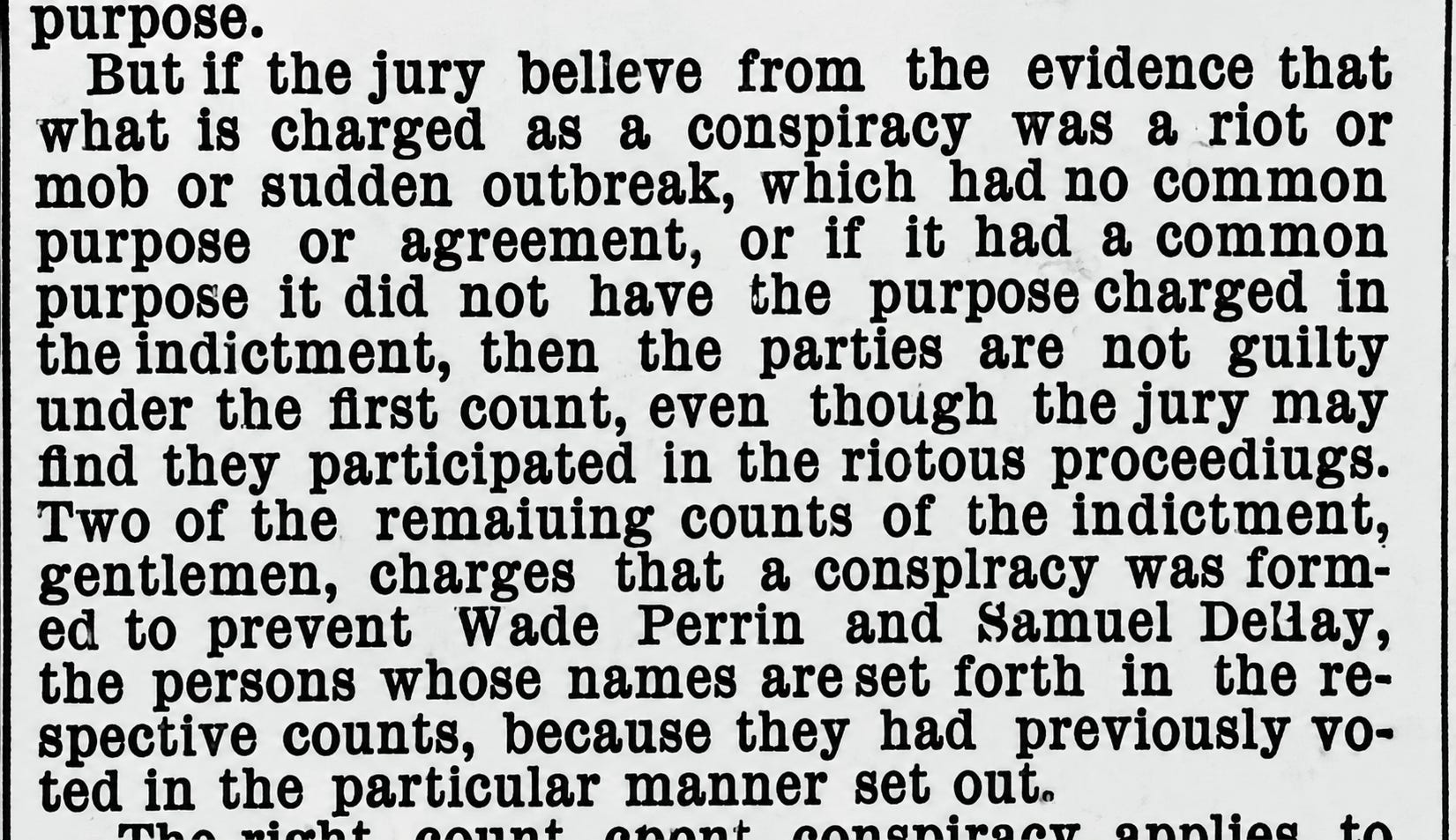
Not among those convictions were the men accused of murdering Wade Perrin. Six men were ultimately rounded up. None were charged with murder, which was a state crime, and it wasn’t clear at the time a federal court could hear it, as they were charged with (according to a Dec. 16, 1872, newspaper report) “conspiracy to injure, &c., citizens of African descent on account of their suffrage.”
The jury deadlocked. (Two of the men were later re-arrested in 1875 on murder charges, but it’s not clear they were ever tried.)
When the government tried the same statute against the perpetrators of the 1873 Colfax Massacre, in which a white mob killed dozens of black men — by some counts more than a hundred — at a Louisiana courthouse, the Supreme Court threw the convictions out. In United States v. Cruikshank (1876), Chief Justice Morrison Waite reasoned that the rights the defendants had violated constrained only government action, not the conduct of private individuals, so the federal indictment could not stand. The ruling drained the statute of much of its force against private racial violence and helped usher in the retreat of Reconstruction.
In 1873, after Grant’s second inauguration, his administration dropped the pending Klan cases. President Grant pardoned Klansmen already convicted and announced a policy of clemency for those not yet tried. Enforcement Act prosecutions were essentially abandoned after 1874.
The law that would become Section 241 went largely unused for the better part of a century, to be revived in 1966 when the Court sustained the law’s use in United States v. Price, the prosecution arising from the Mississippi murders of the civil rights workers Chaney, Goodman, and Schwerner by a group that included law enforcement officers. The question that likely sank the Perrin prosecution — what constitutes an agreement — was never really specific to the Enforcement Act, which eventually would become Section 241. That’s a problem for every conspiracy charge. The sharpest example comes in the late 1950s.
Even mobsters need an actual agreement
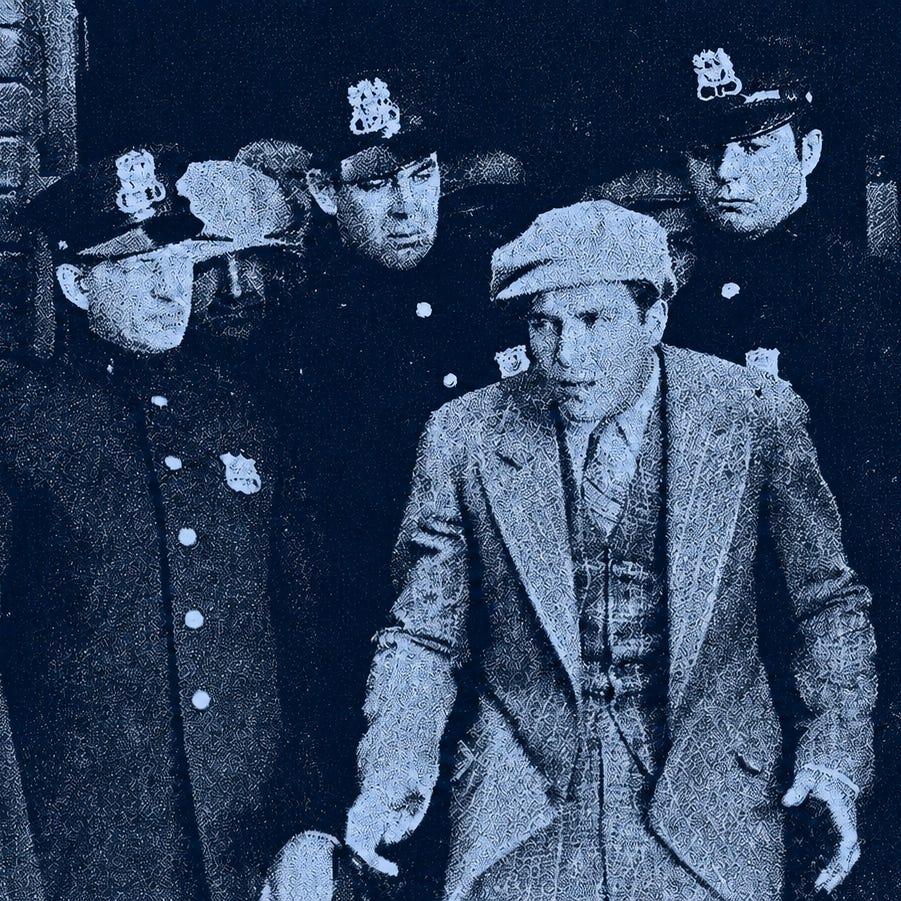
On Nov. 14, 1957, a New York State Police sergeant named Edgar Croswell drove up to a hilltop estate in Apalachin (pronounced app-uh-LAY-kin, not like the mountains), a hamlet near the Pennsylvania border. For some time, Croswell had been watching the property’s owner, a beverage distributor and fine, upstanding pillar of the community named Joseph Barbara, also known as Joe the Barber, a member of the Buffalo crime family. When he drove by on that day, Croswell saw luxury cars with out-of-state license plates. He took down some plate numbers.
What Croswell had stumbled onto was a national summit of organized-crime leaders. Officially speaking, to this day, nobody can authoritatively establish why leading figures from mob territories across the country decided to visit the quiet hamlet of Apalachin. Unofficially, in years since and through much later informant testimony, the likely purpose was that Vito Genovese wanted to cement his own ascendancy and settle the division of the late Albert Anastasia’s operations, after Anastasia suddenly and involuntarily vacated his position as head of what would become the Gambino crime family.
That’s parallel conduct, but parallel conduct isn’t conspiracy.
When state troopers set up roadblocks around the estate, the gathering dissolved into farce — men in expensive suits fleeing on foot through the woods — and officers detained roughly 60 mob figures from across the country. Among them was a Pennsylvania underboss named Russell Bufalino. Asked why they had come, the men gave nearly identical answers: they had heard their friend Barbara was unwell and had stopped by to wish him well.
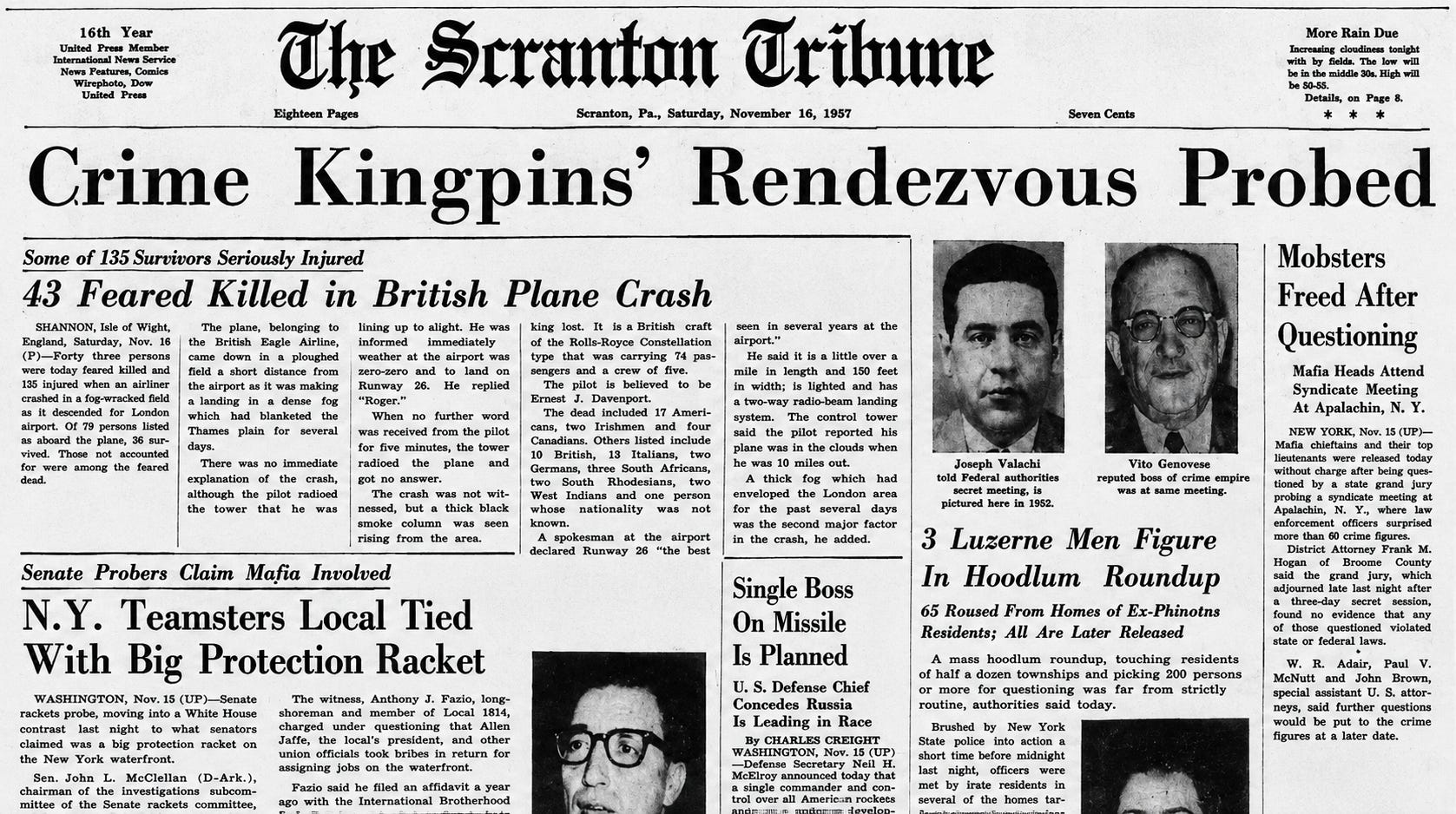
The raid was a watershed. It forced J. Edgar Hoover’s FBI, which had long denied that a national crime syndicate existed, to concede otherwise. But it left prosecutors with a familiar problem. Attending a meeting is not a crime. And because the government didn’t have the benefit of hindsight that we do, it admitted at trial that it could offer no evidence of the gathering’s purpose. So it charged about 20 attendees under the general federal conspiracy statute, 18 U.S.C. § 371, with a different offense — conspiring to obstruct justice and commit perjury — on the theory that because the men had given the same evasive account of their visit, they must have agreed among themselves to conceal it. A jury convicted, and the men drew prison terms of three to five years.
The Second Circuit reversed every conviction. In United States v. Bufalino, the court explained that the similarity of the men’s stories proved nothing about coordination. Each had an obvious and independent reason to be guarded about an afternoon in that company, and the government offered insufficient evidence that they had agreed to lie, versus individually decided to lie.
In the cold light of day, what the government had was a bunch of disreputable people acting evasively when grilled by the cops. That’s parallel conduct, but parallel conduct isn’t conspiracy. Broadly speaking, people who join a secret society are individually adequately motivated not to tell law enforcement about its dealings. No further agreement is required.
The conspiracy that wasn’t
In the fall of 2016, one of the louder pro-Trump voices on Twitter belonged to a man who did not exist. “Ricky Vaughn,” a name borrowed from Charlie Sheen’s wild-pitching character in Major League, was the alias of a Florida man named Douglass Mackey, who by Election Day had a large following and a talent for the provocations that travel fastest online. His posts drew congressional notice the next year in connection with alleged social-media interference in the presidential race.
The posts at the center of his case were three posts or reposts containing deceptive vote-by-text memes. One showed a black woman in front of an “African Americans for Hillary” sign next to an inviting instruction: “Avoid the Line. Vote from Home.”
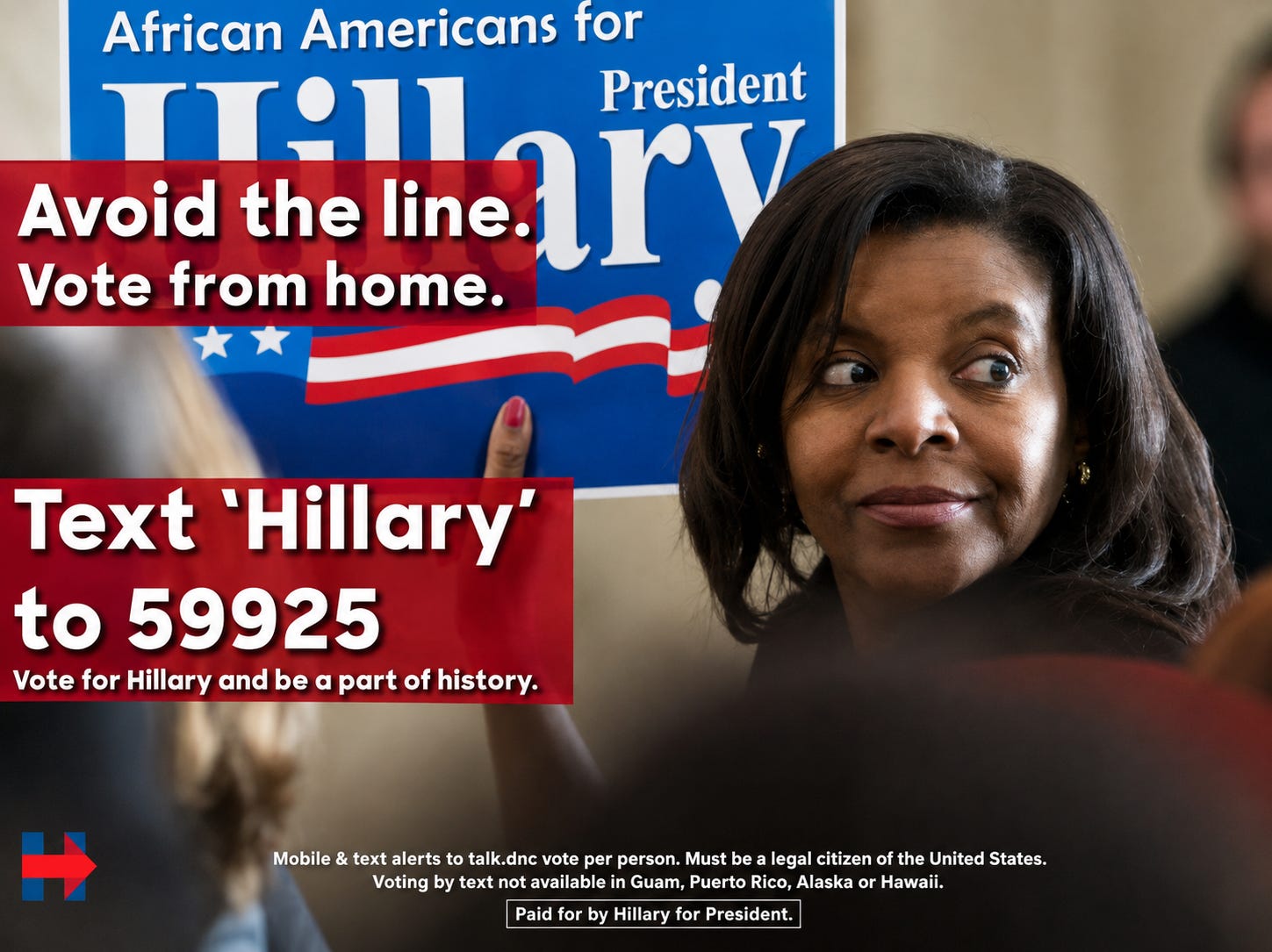
There is no such way to vote, which was the joke, or the scheme, depending on who described it. At trial, the government said at least 4,900 unique phone numbers texted Hillary Clinton’s name or a variation of it to the number promoted in the images, though it offered no evidence that anyone was actually kept from voting. Mackey had not invented the memes; they were publicly available and widely circulated, pulled from the open internet, and he posted them, he later testified, for attention.
Then, for years, nothing. The memes were public and the controversy was public, and the matter sat untouched through the entire Trump administration. Only in January 2021, more than four years after the memes appeared but only two days after President Biden’s inauguration, did the government charge Mackey with a single count of conspiring to “injure, oppress, threaten, and intimidate” citizens in the exercise of their right to vote.
Federal agents took Mackey into custody at his Florida home on the morning of Jan. 27, 2021. By his account, he was handcuffed and driven to the courthouse before anyone told him the charge. He appeared before a magistrate and was released on bond.

The government’s theory was conspiracy. Mackey, prosecutors said, had joined a loose group of pseudonymous influencers who coordinated in private Twitter message groups to push deceptive material at Clinton supporters. He was tried in Brooklyn in early 2023, and the jury convicted him on the single count, though only after the jury repeatedly told the court it was deadlocked. He was sentenced to seven months in prison, and the Second Circuit let him remain free during his appeal — a signal in itself, since that bond requires a finding that the appeal raises substantial questions.
It raised one the court found decisive. In July 2025, a unanimous panel reversed the conviction and ordered the trial court to enter a judgment of acquittal. The failure was the one the Mafia conspiracy prosecution had named more than 60 years earlier: the government proved that Mackey posted the memes but not that he had agreed with anyone to do so.
And it should have known that.
Mackey had not even been a member of the private message groups during the period when the conspiracy was supposedly formed, and according to the appellate court, the government “failed to offer sufficient evidence that Mackey even viewed — let alone participated in — any of these exchanges.” This was, once again, parallel conduct, not a conspiracy. The case turned on the single word the statute is built around — “conspiracy” — and on the government’s failure to prove it. The Second Circuit never actually reached Mackey’s First Amendment defense.
Squeezing Lemon into a conspiracy
Don Lemon spent 17 years at CNN, where he anchored its prime-time hours before leaving in 2023 for an independent career. On Jan. 18, 2026, a group of protesters entered Cities Church in St. Paul during a Sunday service. Their grievance was specific: they said one of the church’s pastors was an official at the local ICE office.
Lemon was there with a camera, livestreaming. What he was doing there is the heart of the case. The government describes a coordinated takeover of a house of worship; Lemon says he was a journalist covering a newsworthy protest. Lemon’s footage of the event is public and he has maintained throughout that he was working as a reporter.
Prosecutors allege that specific things about Lemon’s coverage indicate his intent to participate in a conspiracy. For example, the indictment notes that during interviews, Lemon would “remind certain co-conspirators to not disclose the target of the operation” and that he “stepped away momentarily so his mic would not accidentally divulge” parts of the planning. At one point he thanked an organizer for her actions and reiterated that he wasn’t disclosing plans for the protest. During his narration, Lemon said the “whole point of it is to disrupt and make people uncomfortable.”
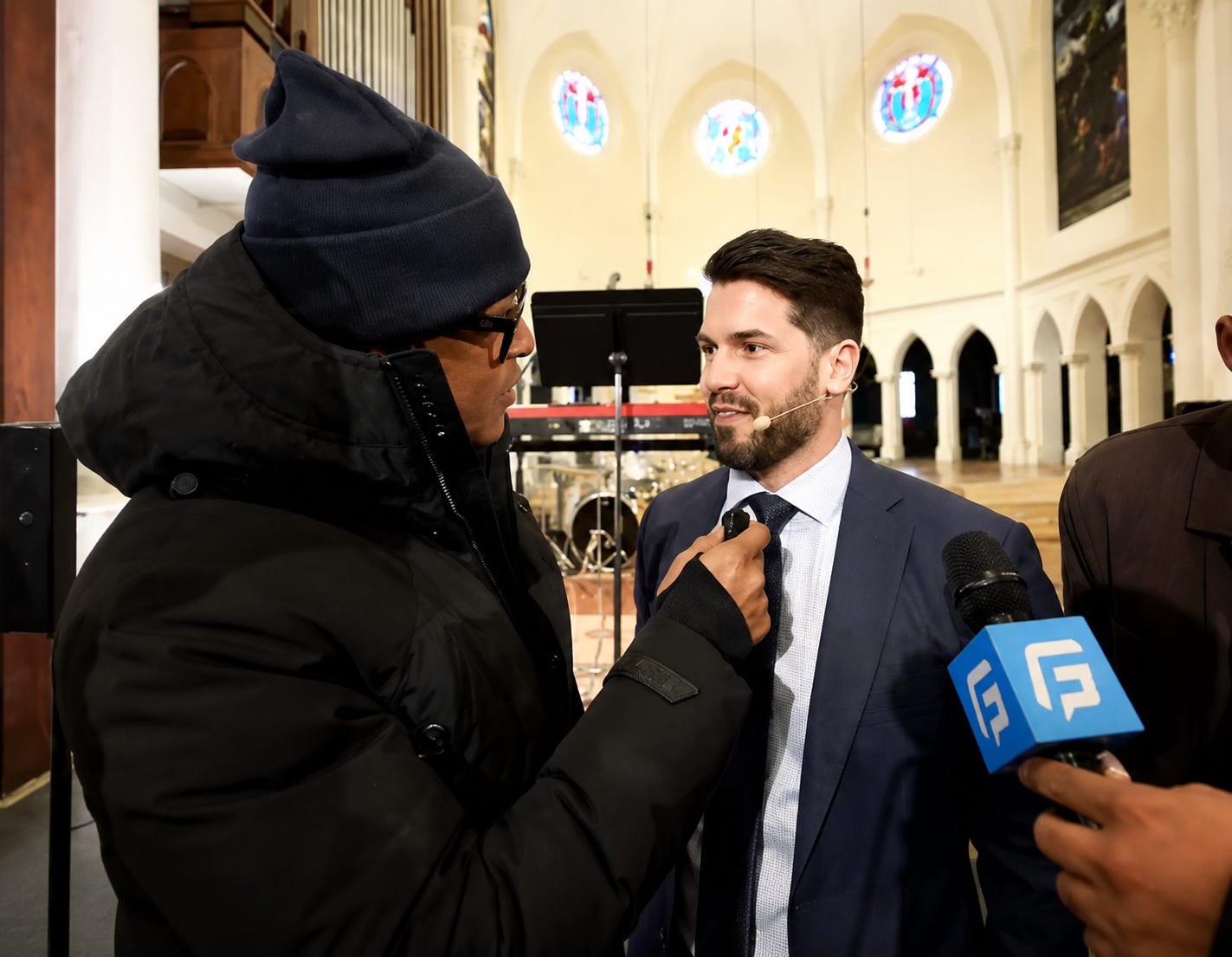
Lemon was charged with conspiracy against the right to exercise religious freedom at a place of worship — Section 241 again — along with a count under the Freedom of Access to Clinic Entrances Act, the 1994 law, usually invoked to protect abortion clinics, that also reaches interference with religious worship (we’re going to focus on the conspiracy charge here). It is unclear whether the government has ever invoked Section 241 to protect First Amendment religious exercise before.
That novelty might explain how hard it was to get the charge in the first place. The Justice Department first sought arrest warrants from a federal magistrate judge in Minnesota, who found no probable cause as to Lemon and his producer even while signing warrants for several of the protesters. Prosecutors then pressed the matter to the district’s chief judge, Patrick J. Schiltz, who declined to grant their request immediately. Schiltz’s written response was pointed: the government had lumped all eight protesters together, asserting things true of some but not all; two of the five it wanted arrested were “not protestors at all” but “a journalist and his producer”; and there was “no evidence that those two engaged in any criminal behavior or conspired to do so.”
The Justice Department sought relief from the Eighth Circuit without success. Only then, having been turned away by every judge asked to examine the evidence, did it take the route that needs no judge’s sign-off: a grand jury indictment, returned Jan. 29. Lemon was arrested the next day. Some career Justice Department prosecutors reportedly declined to take part in charging Lemon and the other journalists, believing the evidence insufficient.
Journalists hold no special license to break generally applicable laws. Once the pastor asked Lemon to leave, he no longer had a right to stay, and the protesters’ decision to commandeer a private house of worship to deliver a political message was not protected expression.
A trespass could be charged as a trespass. But Lemon was not charged with trespassing. He was charged with conspiracy against rights. Unlike the general federal conspiracy statute used in Bufalino, Section 241 requires proof that he conspired to deprive the congregation of its religious freedom, and that charge demands proof of something the others would not: that he knowingly agreed with others to do this thing, and that he or his co-conspirators threatened or physically obstructed congregants.
Presence and sympathy alone do not a conspiracy make.
The question is whether the government has that evidence. What they put in the indictment was: Lemon used the word “we.” He thanked an organizer and said he would not reveal the target on his stream. He narrated the day for his audience and stood closer to the action than a cautious reporter might. The government recasts each of these as an overt act in a criminal agreement. In fact, seven of the 28 enumerated overt acts are First Amendment activities such as word choice, livestreaming, and the editorial discretion of what not to share. But sharing a group’s general purpose is not the same as joining its unlawful one, and the Mackey panel was explicit that the government cannot establish an agreement by pitching a shared purpose at a high level of generality.
Lemon’s opposition to the pastor’s immigration work, which he made no effort to hide, supplies that general purpose. Whether the evidence supplies anything more remains to be seen.
Lemon is closer to the line than Mackey ever was. Mackey was never in the room where the scheme was built. For Mackey’s case to have been a conspiracy, the government would’ve needed to supply evidence of his telepathic ability. Lemon was in the room and spoke in the first person plural once he arrived. But presence and sympathy alone do not a conspiracy make. Based on the publicly available evidence, it is far from clear that Lemon entered into the agreement that the conspiracy charge requires.
There’s a second issue with using 241 in this way: it protects rights secured by the Constitution or U.S. law. The right to freedom of religion runs only against the government. A private citizen who disrupts a worship service does many things, but is not in a position to violate the First Amendment. That’s the same type of line the Supreme Court drew in Cruikshank in 1876.
And this is where Lemon’s FACE Act charge might come into play, in theory. The Freedom of Access to Clinic Entrances ACT, or FACE Act, is a U.S. law that creates a statutory protection that the protest arguably violated. But that isn’t the charge in the indictment, and that would be the novel use of a statute (the FACE Act) to meet a requirement in a novel use of another statute (Section 241), and it’s an awfully long way from the conspiracies that Section 241 was created to punish.
On Aug. 7, Lemon filed a motion to dismiss the indictment for “violating the First Amendment and failing to state an offense.” Separately, he’s moved to dismiss on the grounds that the indictment is rooted in the president’s “long expressed animosity towards Mr. Lemon based on years of critical reporting.”
Same same
In 1871, federal prosecutors used a conspiracy statute against men in disguise who rode at night to keep their neighbors from voting. In 1966, they used it against the murderers of three young men who had come to Mississippi to register voters.
In 2021, they used it against a man who posted a meme. In 2026, against a journalist who filmed a protest.
The two modern defendants would recognize almost nothing in each other, which is why their cases belong side by side. In Mackey’s, the Second Circuit did not ask whether his politics were attractive or his memes defensible. It asked whether the government had proved he agreed to anything, and finding that it had not, ordered him acquitted. The courts weighing Lemon’s case face the same question, and the answer should not depend on the direction his camera happened to point.
A conspiracy statute with an elastic notion of agreement is proving to be a lure that prosecutors can’t resist. The safeguards against abuse are unglamorous: an agreement that must actually be proved, a right that must actually be denied, force that must actually be used. Applied with rigor, those safeguards spared a meme-maker under one administration. A journalist facing prosecution under the next is owed the same rigor, no more and no less, and none of it turning on politics.

I appreciate your going into the detailed history of the law that the government is trying to use. Most of us lack the knowledge to assess what is going on in court cases so we excited about irrelevancies, and we don't always know when the legal system has failed vs succeeded on its own terms.
There is nothing in this world evil that doesn't fall under the same global conspiracy umbrella.
One minor example among thousand this would be the fact that the US itself is a conspiracy operation. Always has been.
The CIA admitted that conspiracies are everywhere when they intentionally confused people by acquainting the term conspiracy theory in 1967. It literally means the same thing as conspiracy fact.
They like messing with people's minds, which is why they didn't call it conspiracy hypothesis. And the sleepy sheeple never catch on....
The really clueless people don't know what foreign faction all of the orders come from.