


“We are going to court to defend our journalists’ rights to report freely on the administration and to provide the public with stories that matter.”
— David McCraw, senior vice president of The New York Times on filing a motion to quash subpoenas served on journalists over Air Force One coverage.
America is failing its own free speech standards
Federal agents showed up at a New York man’s home over an email telling former ICE head Todd Lyons his conscience will haunt him forever. That’s the sort of government response Americans usually criticize abroad, not something we should normalize here.
“Even children sitting in their first American civics class could tell you that freedom is most adequately defined by what we are free from,” Sarah McLaughlin writes for The Next Move. “It’s time our leaders relearned that lesson.”
Colleges pay fat settlements over Kirk firings
Public colleges and other government employers that punished faculty and staff for protected speech about Charlie Kirk’s assassination are now writing checks worth hundreds of thousands, and in some cases millions, of dollars. It’s a costly reminder that government officials don’t get to suspend constitutional rights without paying the price.
“Just as the First Amendment protects those who praise Kirk’s work and legacy,” writes Graham Piro, “it also protects those who criticize the man. A cancel-culture cycle in the wake of a tragedy is nothing new. But censoring speech only scares people from voicing their opinions.”
Below the fold
Michigan State University’s new ethics policy tells trustees to keep disagreements behind closed doors once the board votes. That’s tidy for administrators, but not so much for journalists, who just lost some of their best sources. Marie McMullan tells the story and explains why the policy raises serious transparency and First Amendment concerns.
The New York Times wants a federal court to quash grand jury subpoenas served on reporters for their coverage of security concerns over President Trump’s Qatari-donated aircraft. The paper says the subpoenas strike at the heart of press freedom by threatening journalists’ ability to gather news and protect sources. The case could become a major test of federal protections for reporters.
International
Germany is considering legislation that would make publicly denying Israel’s right to exist a crime punishable by up to five years in prison. Whether one agrees with the sentiment or not, it’s another reminder of how dramatically European speech laws diverge from the First Amendment’s much broader protections.
A newly disclosed Canadian government memo reveals officials are developing a national strategy to combat misinformation. Exactly what that entails remains anyone’s guess, thanks to heavily redacted sections discussing possible legal action. That uncertainty alone is enough to raise concerns about government pressure on platforms — or worse, penalties for protected speech dressed up as anti-misinformation efforts.
In her latest Free Speech Dispatch, Sarah McLaughlin tells how the global crusade to ban teens from social media is advancing across Europe, Hong Kong arrested five booksellers on sedition charges, Germany brought new criminal charges against author CJ Hopkins, JK Rowling is suing Amnesty UK, and SpongeBob SquarePants has run afoul of Russia’s LGBT ban.

Tech
In the latest in our ongoing series on AI and free speech, John Coleman asks a deceptively simple question: Should you have to flash your ID before asking a chatbot a question? He argues that age-gating can quickly morph into full-blown ID checks, requiring selfies, biometric scans, government IDs, or other personal data just to access lawful information. The result, Coleman warns, could be a “papers, please” internet where people think twice before researching sensitive topics, exploring controversial ideas, or even asking awkward questions — because nothing encourages free inquiry quite like having to upload your driver’s license first.
Government


Culture
Podcasts
So to Speak takes an uncensored look at the world of free expression through the law, philosophy, and stories that define it, hosted by FIRE’s Nico Perrino.
In this episode, Nico sits down with University of Chicago professor Ada Palmer to explore the history of censorship from the Renaissance to the present day. They discuss what motivates censorship, why it evolves alongside new communication technologies, how effective it has been throughout history, and what historical patterns can teach us about today’s free speech debates.
The Blessings of Liberty explores constitutional history, Supreme Court debates, and the “American Idea,” hosted by bestselling author and constitutional scholar Jeffrey Rosen.
In this episode, New York Times journalist Jesse Wegman joins to discuss his new book, The Lost Founder: James Wilson and the Forgotten Fight for a People’s Constitution. This biography tells the story of James Wilson, a Founding Father whose bold vision shaped American democracy, but whose legacy was lost to scandal.
Today in history with Sheridan Macy
On July 14, 1798, President John Adams signed the Sedition Act into law as part of the Alien and Sedition Acts, a package of laws that lengthened the naturalization process, expanded the president’s authority to detain and deport noncitizens, and restricted political speech. The Sedition Act made it a crime to publish “false, scandalous, and malicious writing” against the federal government, Congress, or the president. In practice, the law was used to silence critics of the Adams administration. Newspaper editors, publishers, and political opponents affiliated with Thomas Jefferson’s Democratic-Republican Party were among those prosecuted.
One of the Act’s earliest targets was Benjamin Franklin Bache, grandson of Benjamin Franklin and editor of the Philadelphia Aurora. In September 1798, Bache was arrested on charges of seditious libel after accusing Adams of nepotism and mocking him as “the blind, bald, crippled, toothless, querulous Adams.” He was released on bail but died of yellow fever before his trial. The law — which expired on the final day of Adams’s presidency in 1801, after Congress declined to renew it — also reached ordinary citizens. Luther Baldwin was convicted and fined $100 after, upon hearing a cannon salute during a parade attended by Adams in Newark, New Jersey, he remarked, “I hope it hit Adams in the backside.”
By the numbers
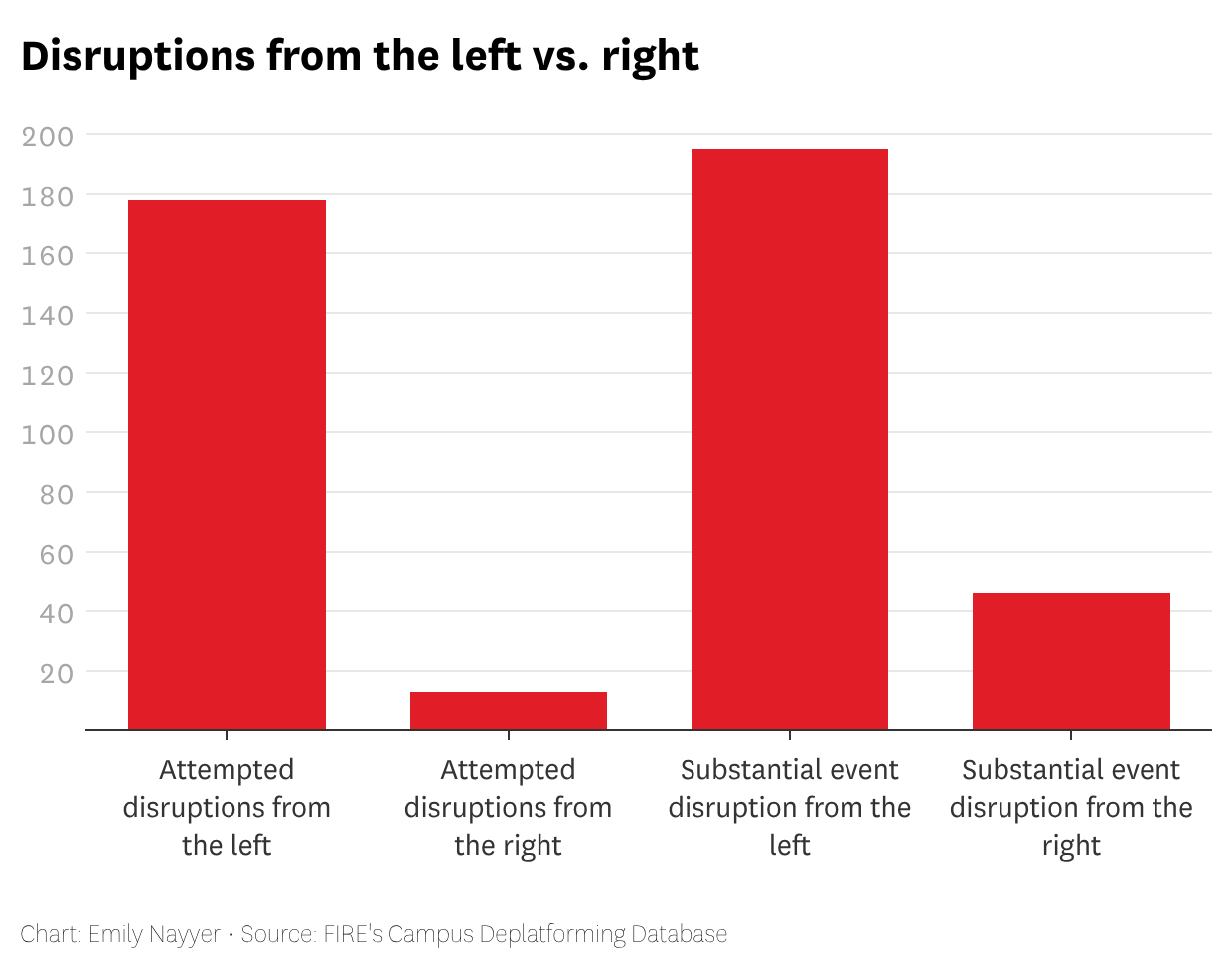
While censorship efforts from the left and the right occur with similar frequency, writes Sean Stevens, they take fundamentally different forms.
Efforts from the left typically originate on campus and are usually led by students, while efforts from the right typically originate off campus and are usually led by activist groups, public officials, or wealthy donors. Efforts from the left tend to use op-eds, social media, and online petitions to get their message across while efforts from the right threaten budgets, launch investigations, and demand resignations.
Another major difference is that efforts from the left tend to be more successful — about 50% succeed, compared to only about 40% from the right.
Speaking of the Sedition Act of 1798, supporters of the freedom of speech and press and the right to petition would do well to recall the important respects in which the Act greatly enhanced the due process protections for such right and freedom. These days, SCOTUS justices (esp. Thomas and Gorsuch) are seeking to undermine those protections with the falsehood that such protections bear “no relation to the text, history, or structure of the Constitution.” See, e.g., https://thehill.com/opinion/judiciary/supreme-court/5961095-defamation-threat-free-speech/
For hundreds of years before our Constitution was written and ratified by and for the People, people in power in Britain and in the American colonies had viciously punished their critics. The Star Chamber and the so-called "legislative privilege" even had established as a matter of law that even truthful statements could be punished. Truth was an element of the crime of seditious libel or the crime of breach of the privilege of the people who held political power, not a defense.
By the way, for a powerful recent example of an attempt to punish people for truthfully breaching the "privilege" of people in power, we need not look far. Consider the conduct of Chief Justice Roberts and SCOTUS employees seeking to punish whoever "leaked" a copy of the nearly-final opinions of SCOTUS justices in Dobbs. There was no legitimate or lawful reason to conceal from the American public the information that was included in those opinions.
The Sedition Act established (and President Adams meant it to establish) due process protections for criticism of people in power. The law expressly protected even very harsh criticism of people in power. It expressly protected bringing any federal officials “into contempt or disrepute” and even “excit[ing] against them” the “hatred” of the “people” unless the government proved (beyond a reasonable doubt) material facts establishing how a writing was “false" as well as "scandalous, and malicious."
The due process protections of the Sedition Act of 1798 featured prominently in two unanimous SCOTUS decisions in 1964: New York Times Co. v. Sullivan and Garrison v. Louisiana. Those decisions and their progeny established that our Constitution required powerful due process protections for criticism of people with even the greatest political or social power.
"[T]the people of this nation have ordained in the light of history” that “these liberties” are “essential to enlightened opinion and right conduct on the part of” all American “citizens” and our public servants. See Sullivan. Our "Constitution created a form of government under which ‘The people, not the government, possess the absolute sovereignty,’ so in our "Republican Government," in general, "the censorial power is in the people over the Government, and not in the Government over the people.’ " Sullivan quoting James Madison.
The “public interest in a free flow of information to the people concerning public officials, their servants” is “paramount,” so “anything which” even “might touch on an official’s fitness for office is relevant,” including a purported or potential public servant's “dishonesty, malfeasance, or improper motivation.” See Garrison. Even “resorts” to “exaggeration” and “vilification of men who have been, or are, prominent” are protected. See Sullivan.
"The constitutional protection does not turn upon ‘the truth, popularity, or social utility of the ideas and beliefs which are offered." See Sullivan. Moreover, our Constitution precludes "any test of truth" that "puts the burden of proving truth on the speaker." See Sullivan. "The constitutional guarantees require" a "federal rule that" protects criticism "relating to [a public servant's] official conduct" until someone has proved how such criticism was a "falsehood" and "that the statement was made with 'actual malice'—that is, with knowledge that it was false or with reckless disregard of whether it was false or not." See Sullivan.
Any purported “proof presented to show” each material fact must have “the convincing clarity which the constitutional standard demands.” See Sullivan. Outside the criminal context (in which the government must bear the burden of proof beyond a reasonable doubt) "the First Amendment mandates a ‘clear and convincing’ standard” of proof of each material fact. Anderson v. Liberty Lobby, Inc. (1986).
“Truth may not be the subject of” any type of content-based “sanctions” “where discussion of public affairs is concerned,” so “only” such “statements” as have been proved to be “false” may be punished with “either civil or criminal sanctions.” See Garrison. Our Constitution “absolutely prohibits” any content-based “punishment of truthful criticism” of any public servant’s public service. See Garrison. Accord Pickering v. Board of Ed. (1968) (government employee’s “dismissal” precluded “absent proof of false statements knowingly or recklessly made”).
Speech that is being punished or penalized must at least “imply” an “assertion of fact” that was proved “false.” Milkovich v. Lorain Journal Co. (1990). Any expression or communication “relating to matters of public concern” must “receive full constitutional protection” until someone has proved how an assertion or implication was factually false or at least "contain[ed]" a “false factual connotation.”
“proposed rules for federal research grants, which would give political appointees a killswitch to halt research in progress for any reason.”
The people are sovereign and are not beholden to appointed experts. Of course, our elected executives and their at-will appointees control our public expenditures, for any legal reason.