


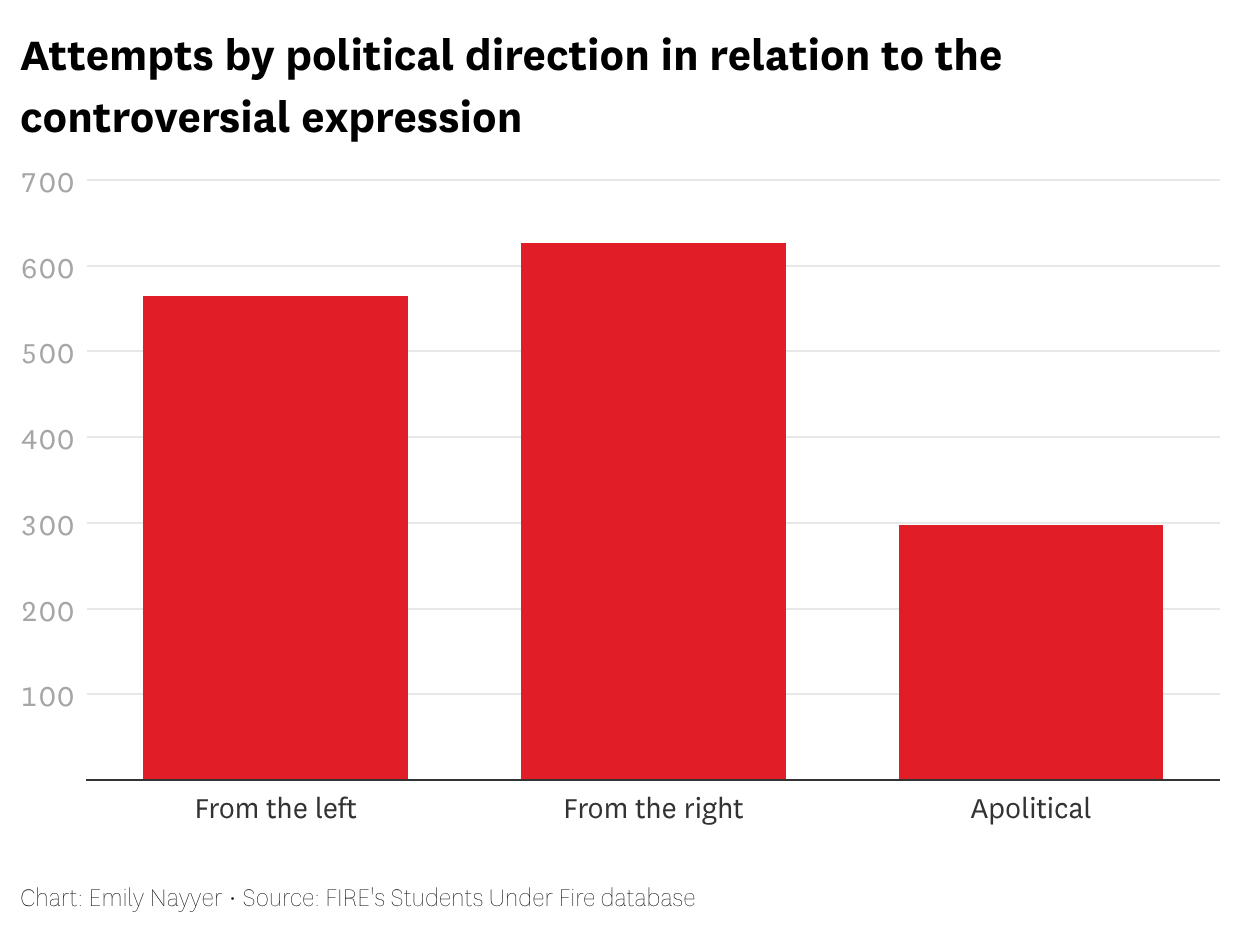
FIRE’s Students Under Fire database tracks publicly known attempts since 2020 to investigate, censor, or punish students for expression protected by the First Amendment, or that would be protected at a public institution. Each entry records the attempt’s political direction relative to the targeted expression. One in five attempts is apolitical. Among the rest, 53% come from the right and 47% from the left (as of July 30, 2026).
When it comes to efforts against students, on-campus attempts usually come from the left and are often initiated by students or faculty,1 while off-campus attempts usually come from the right and are often initiated by politicians or activist organizations. This is consistent with findings from FIRE’s Campus Deplatforming and Scholars Under Fire databases.
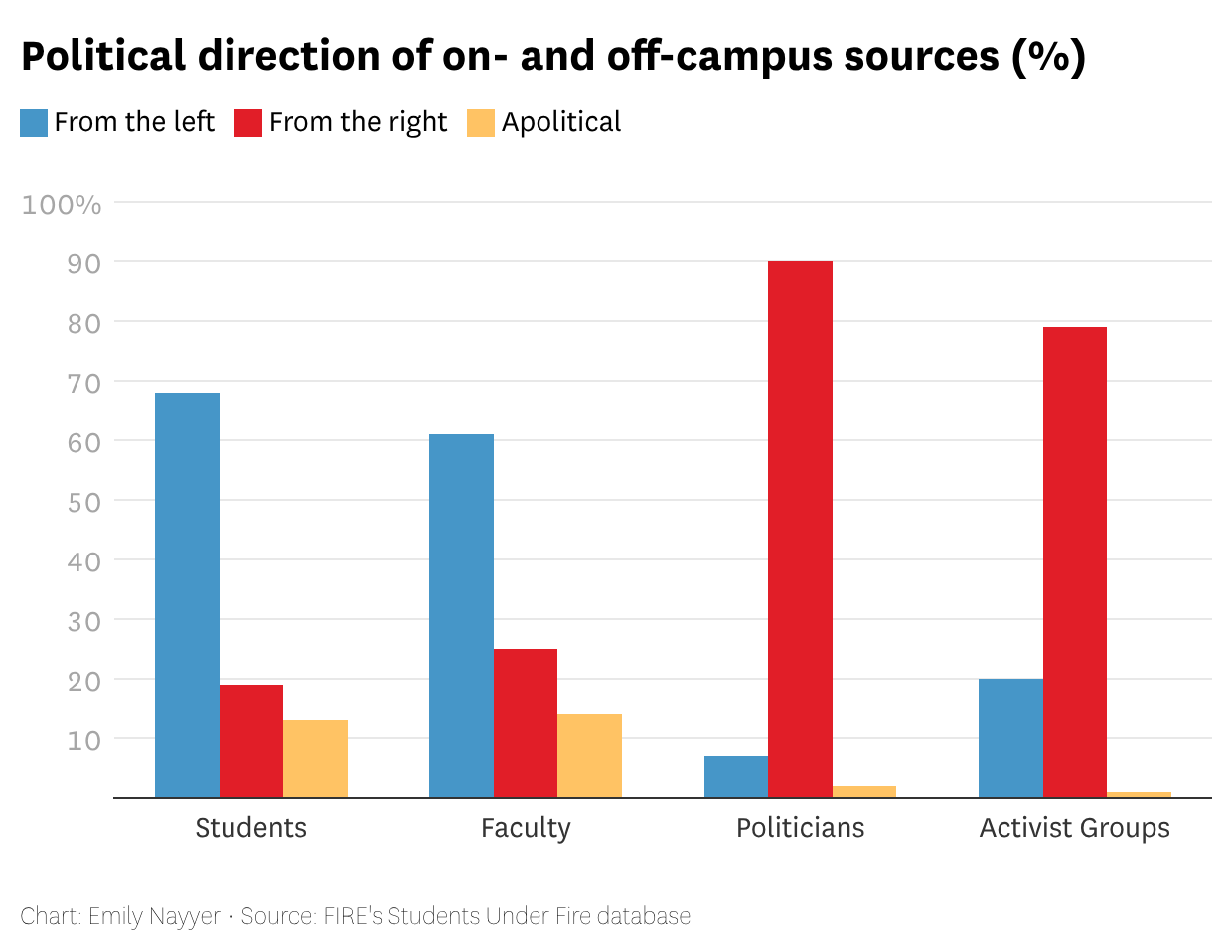
These disparities reflect different sources of influence. On campus, liberals often have strength in numbers among students and faculty, while conservatives off-campus are more likely to rely on public pressure, funding leverage, or political authority.
Administrators ultimately decide whether to punish student expression. The question, then, is which groups exert the most influence over those decisions.
Who succeeds more often?
We define an attempt as “successful” when it results in administrative punishment. Investigations are by far the most common administrative response.
Regardless of source or political direction, censorship attempts succeed at alarming rates. Attempts involving students or faculty result in administrative punishment 42% of the time, compared with 35% for attempts involving activists or politicians.
Individually, faculty-led efforts succeed at the highest rate, 48%, followed by students at 42%, politicians at 41%, and activist groups at 26%.
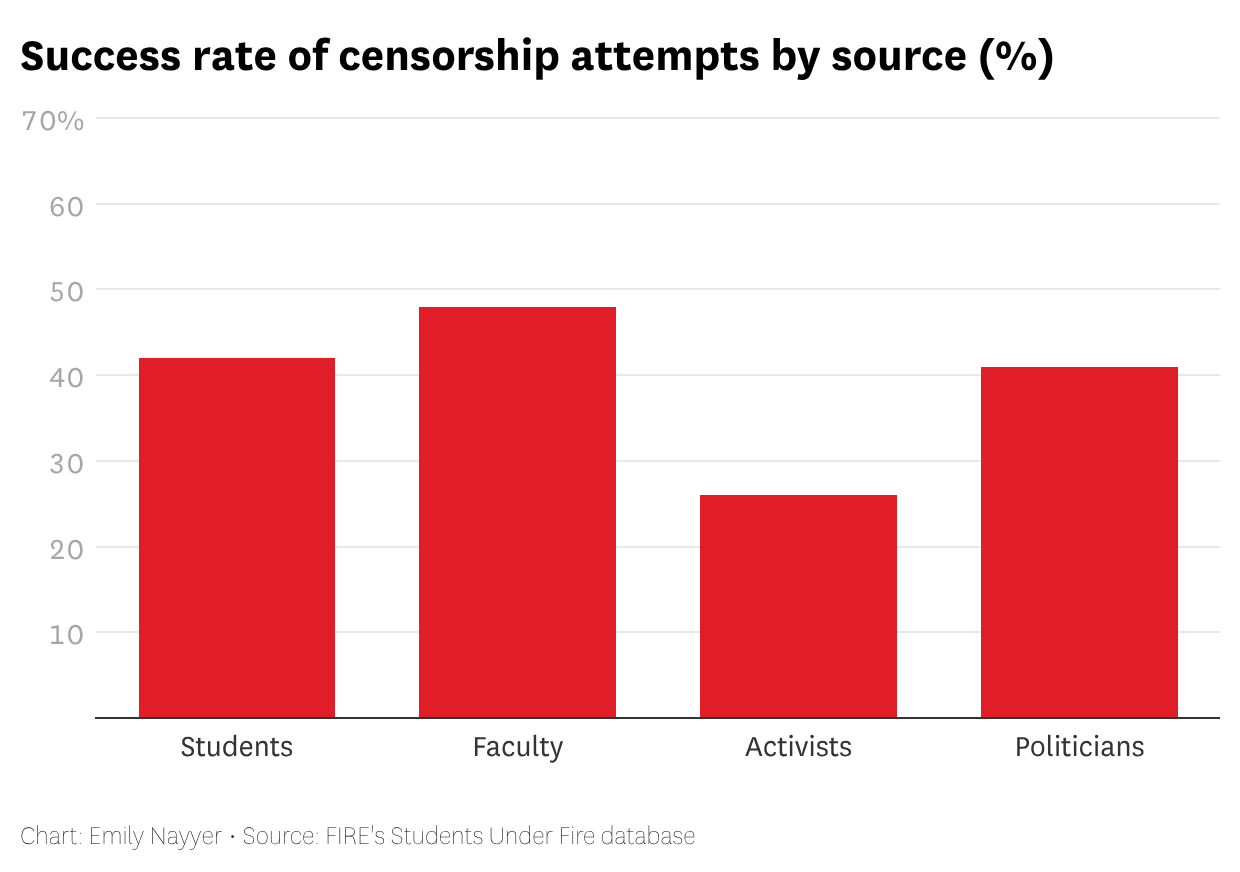
So although on-campus attempts are more numerous, they succeed at roughly the same rate as off-campus attempts. The more revealing difference lies in how administrators respond.
How admins respond
Administrators may issue public statements in response to censorship attempts, and their tone varies by source. When attempts are unsuccessful, their statements are relatively consistent across sources. But when attempts succeed, administrators respond differently to on-campus and off-campus pressure.
When students or faculty are the source of a successful attempt, administrators are twice as likely to condemn the targeted expression. When activists or politicians are the source, administrators are nearly three times as likely to issue a neutral statement.
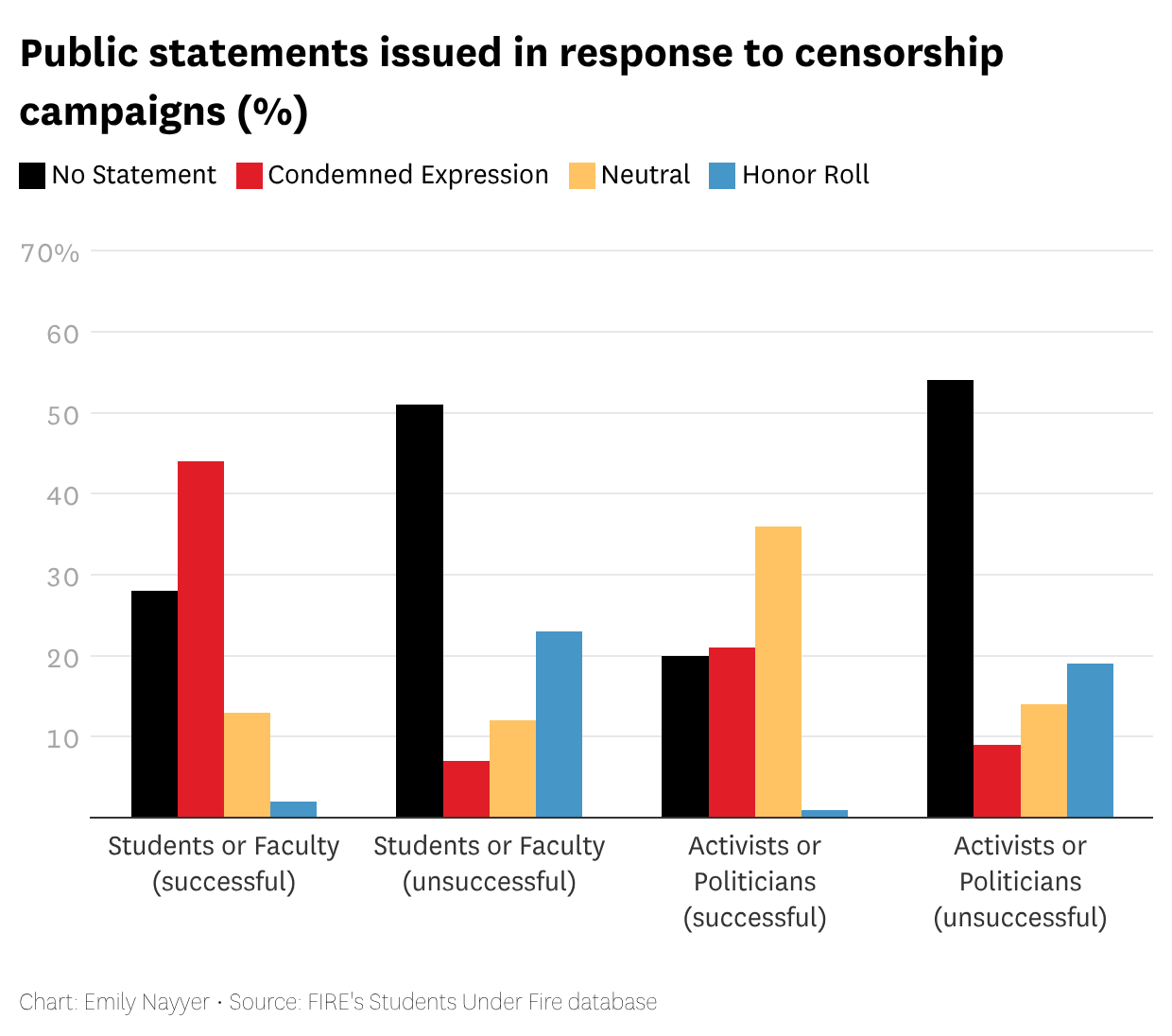
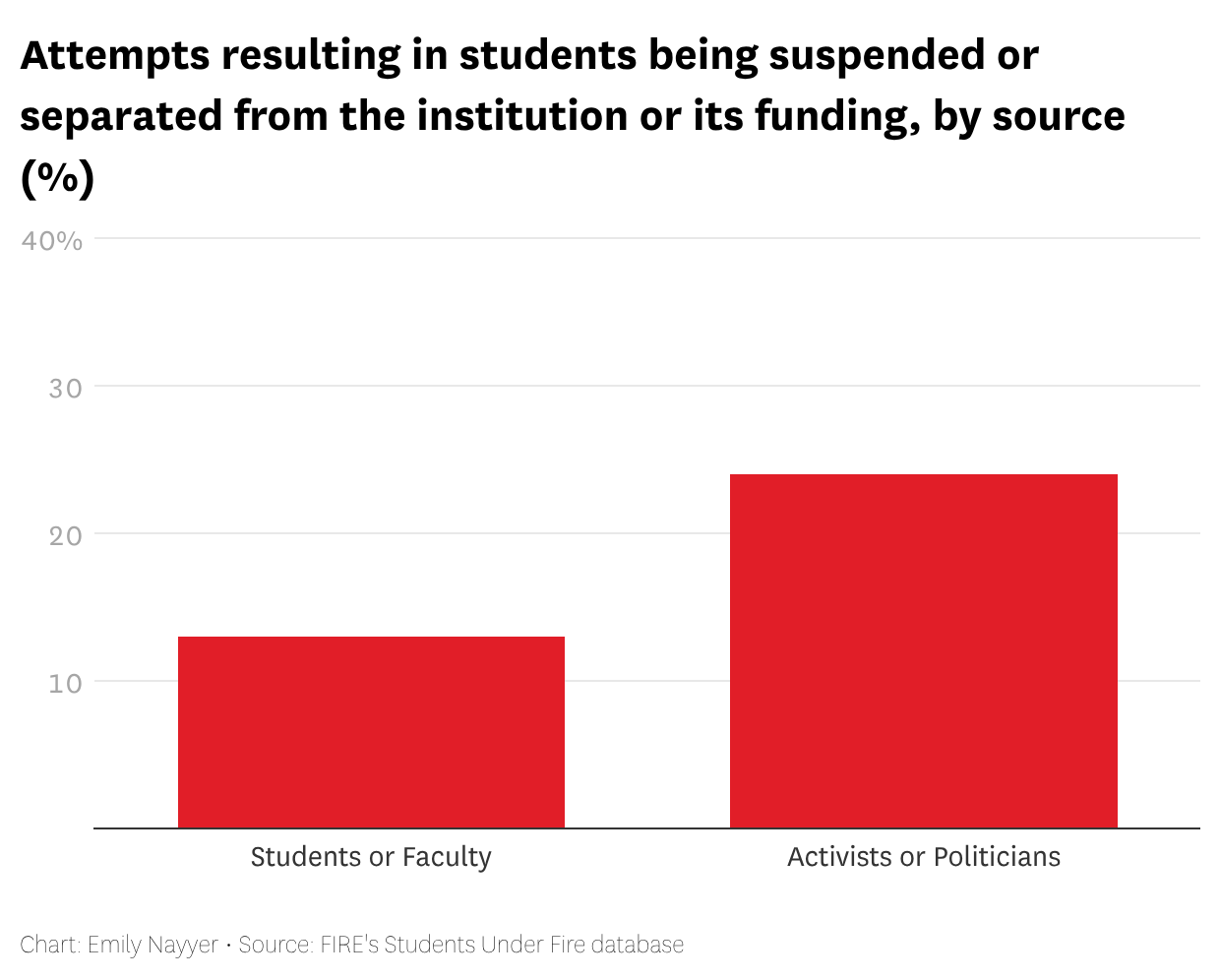
A similar asymmetry appears in punishment severity. Successful attempts by activists or politicians result in students being suspended or separated from the institution or its funding2 24% of the time — nearly double the rate for successful attempts by students or faculty.
What does it mean?
These power dynamics appear to shape how administrators respond to student speech controversies. But whether the pressure comes from students, faculty, activists, or elected officials, administrators should not punish constitutionally protected expression.
Universities can better resist such pressure by adopting the Chicago Statement or a similar free speech policy statement, committing to institutional neutrality, aligning their rules with First Amendment standards, training students on free speech, and consistently defending protected expression.
FIRE stands ready to help.
For student ideology, see FIRE’s 2025 College Free Speech Rankings Survey. For faculty ideology, see our 2024 FIRE Faculty Survey Report, our 2026 report on faculty viewpoint diversity, and our 2022 report on what faculty think about free speech.
Separation includes expelling a student, revoking a student’s offer of admission, or denying or rescinding recognition of a student group.
