“I am permitted to speak my conscience in the United States of America, including when I criticize government officials.”
— David Streever, responding after a judge blocked DHS from acting on a warning notice issued over his email criticizing ICE. See our reporting here.
First things first
A year after Charlie Kirk’s murder, students at Utah Valley University, where he was shot, are less tolerant of violence, more confident administrators will protect them — yet more afraid to speak. Also, new data shows the old left-right gap on violence against speakers has largely closed, not because the left cooled off but because moderates and conservatives rose to the same temperature. Everyone seems to agree violence is unacceptable, but fewer and fewer are willing to test the notion out loud.
Texas professor stuck in limbo
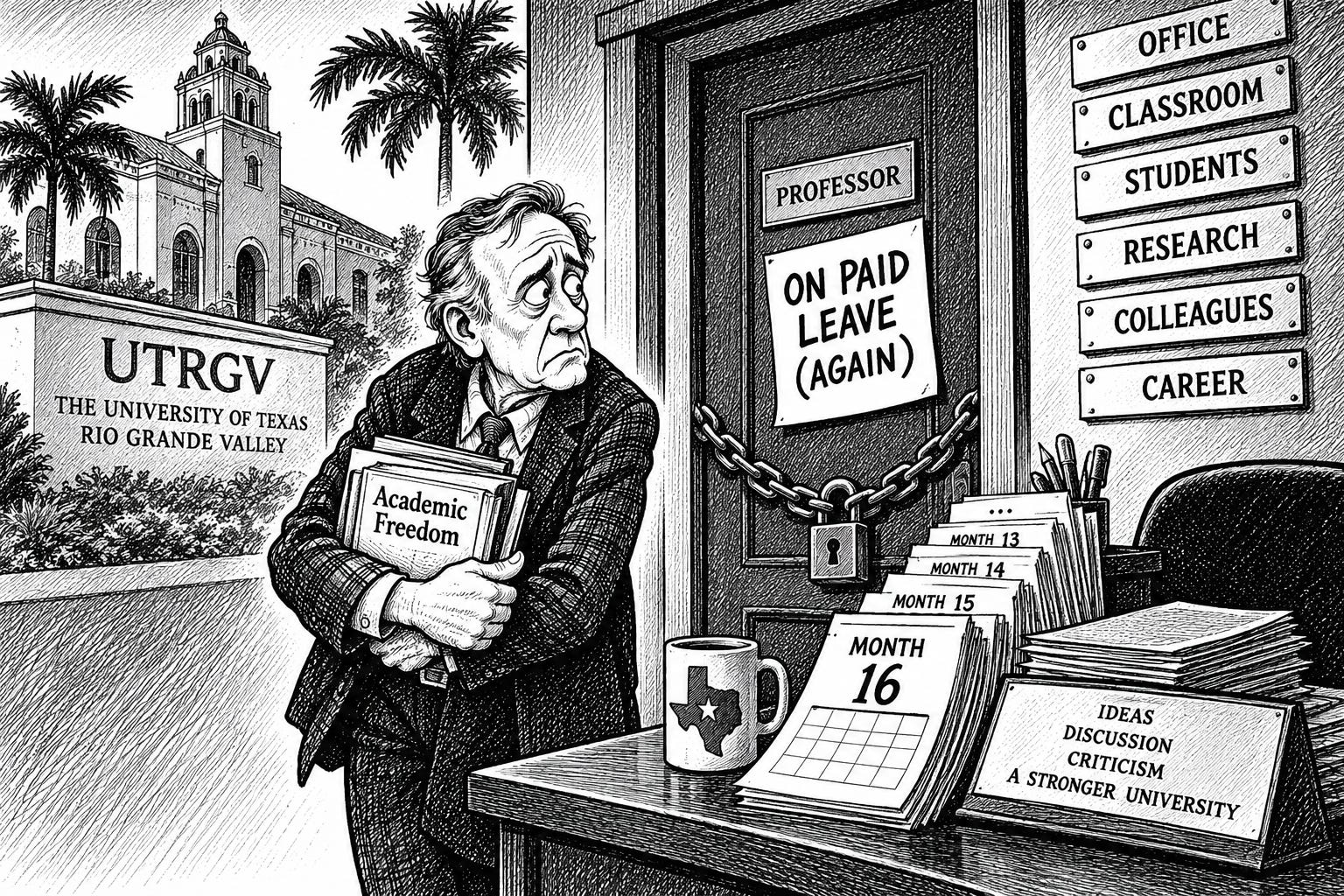
The University of Texas Rio Grande Valley has kept tenured professor Clyde Barrow on paid leave for 16 months — barring him from his office and classroom and leaving unresolved an investigative report that recommended discipline up to termination — after he repeatedly criticized department leadership and university policy.
“If a public university can leave a tenured professor in administrative purgatory for criticizing his bosses,” writes Graham Piro, “then every professor watching is going to learn the same lesson. You may have the right to speak, but exercising it at UTRGV could leave your career frozen indefinitely.”
Below the fold
A year after Charlie Kirk was murdered at Utah Valley University, FIRE’s latest survey finds more than half of UVU students self-censor at least once or twice a month. Writing for The Dispatch, Matthew Harwood reports that students across the political spectrum say the assassination made controversial speech feel dangerous.
Around the world
Alternative for Germany filed a criminal defamation complaint against Chancellor Friedrich Merz after he said the party’s “remigration” policy amounted to “ethnic cleansing,” putting an ugly but quintessentially political dispute before a legal system that already allows prosecutions for insults and defamation of public officials. As Sarah McLaughlin explains:
Criticism, even when it looks more like insult than critique, should be treated as a core component of political debate rather than an aberration of it. It’s disturbing that democratic states, the United States included, are faltering on protecting it. In democracies, voters decide which political parties and candidates deserve power. Those politicians shouldn’t get to decide what can be said about them.
By the numbers
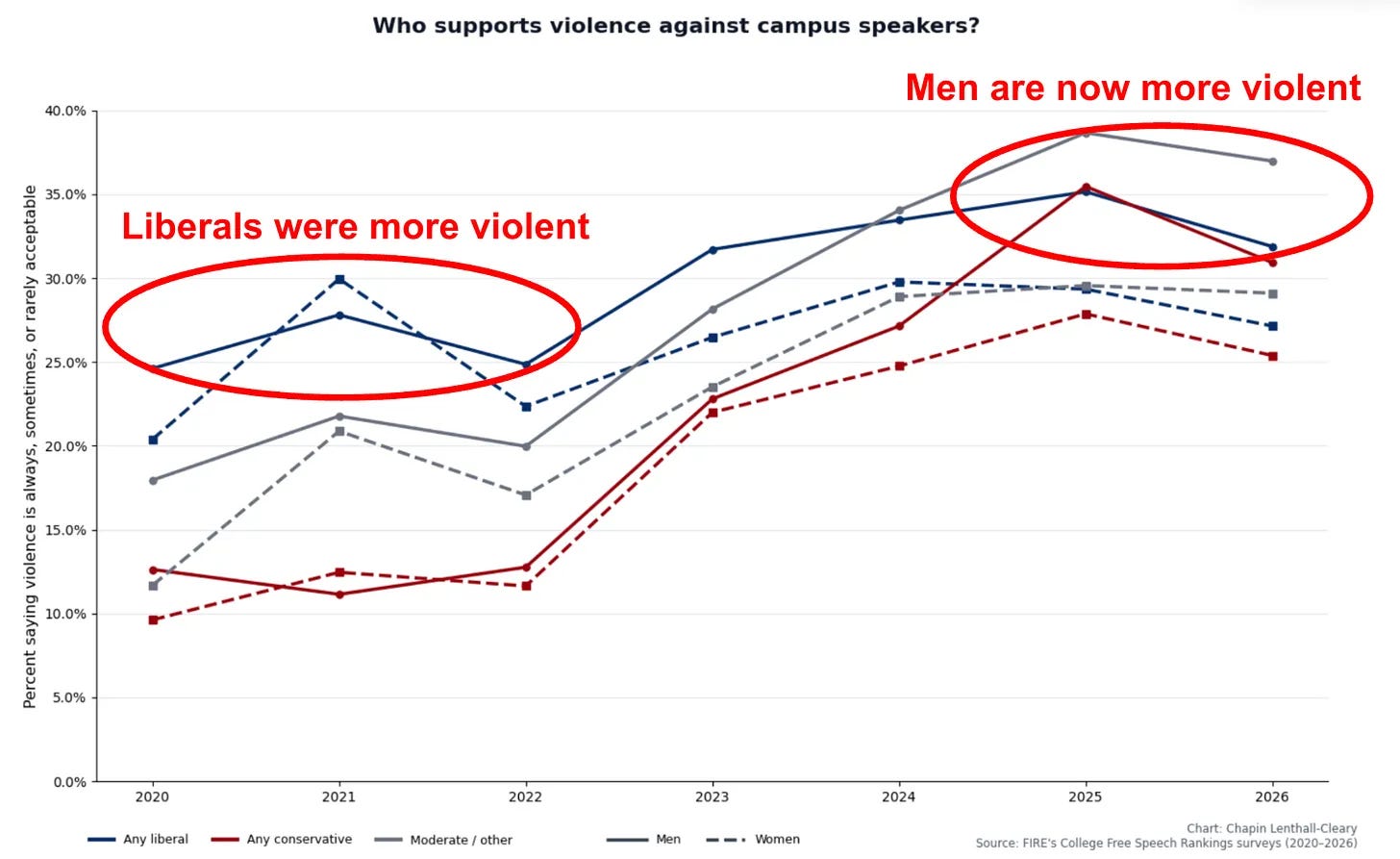
Violence is now a gendered issue, reports Chapin Lenthall-Cleary. An ideological gap in student acceptance of violence against controversial speakers has largely disappeared since 2021, while a gender gap has emerged: Men are now about 30% more accepting of such violence than women after controlling for ideology, even though men are generally more tolerant of allowing controversial speakers to appear.
Worth a listen
The Blessings of Liberty explores constitutional history, Supreme Court debates, and the “American Idea,” hosted by bestselling author and constitutional scholar Jeffrey Rosen.
In this episode, a celebration of Constitution Day, investor, philanthropist, and historian David Rubenstein walks through the nation’s semiquincentennial, the big ideas of the Declaration of Independence and the Constitution, and the importance of learning history and reading books in today’s climate.

So to Speak takes an uncensored look at the world of free expression through the law, philosophy, and stories that define free speech — hosted by FIRE’s Nico Perrino.
In this episode, Nico covers FIRE’s 2027 College Free Speech Rankings with Angela Erickson, Sean Stevens, Ronnie London, and Connor Murnane. The hour-long discussion walks through the methodology — how schools are selected, what students are actually asked, and why FIRE pre-registers its approach — as well as the top and bottom performers and notable movers like Harvard, Claremont McKenna, MIT, and the University of Washington.
Today in history with Sheridan Macy
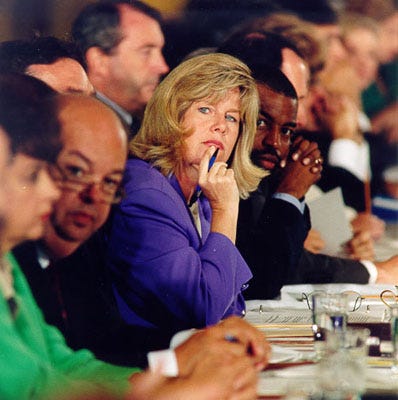
On Sept. 19, 1985, the Senate Commerce, Science, and Transportation Committee held a hearing on record labeling. It was the culmination of a campaign by the Parents Music Resource Center, a bipartisan group founded that May by four women known as the “Washington Wives.” Backed by Mike Love of the Beach Boys and Coors beer’s Joseph Coors, PMRC objected to lyrics and album art depicting sex, violence, drugs, and the occult, naming a “Filthy Fifteen” of the worst-offending songs. It urged the Recording Industry Association of America to voluntarily adopt a label system like that of the Motion Picture Association, but before companies could start applying them, the Senate called a hearing on “porn rock.”
The hearing featured five representatives from the PMRC, including Tipper Gore, and Senators Paula Hawkins and Al Gore, Tipper’s husband. A music professor and a child psychiatrist also testified in favor of PMRC’s labeling proposal. Three musicians — John Denver, Frank Zappa, and Dee Snider — testified against the proposal. Denver, who many had expected to testify in favor of the proposal, said he was “strongly opposed to censorship of any kind in our society or anywhere else in the world,” and compared the proposal to Nazi book burnings. Zappa read the First Amendment aloud to the committee and argued that the proposal would not benefit children, but would tie up the courts with interpretation and enforcement problems.
In November of that year, the RIAA agreed to put parental advisory labels on selected releases. The labels came to be known as the “Tipper Sticker.” Alice Cooper mocked the label policy in his song “Freedom,” which accuses PMRC members of “pretending that [they’ve] never been bad” and wanting to “become Big Brother.” Metallica’s 1986 album Master of Puppets included a mock warning label with a nod to George Carlin:
THE ONLY TRACK YOU PROBABLY WON’T WANT TO PLAY IS “DAMAGE, INC.” DUE TO MULTIPLE USE OF THE INFAMOUS “F” WORD. OTHERWISE, THERE AREN’T ANY “SHITS,” “FUCKS,” “PISSES,” “CUNTS,” “MOTHERFUCKERS” OR “COCKSUCKERS” ANYWHERE ON THIS RECORD.”
In the comments

Ink and opinion