


You’re reading the FIREwire, our weekly roundup of the latest news in free speech.
“This was always going to be a family-friendly event. None of this became ‘harmful’ just because state officials disapproved of our chosen expression.”
— Matt Kezhaya, attorney for The Satanic Temple, after a federal judge ordered Iowa officials this week to allow the group’s holiday event at the state Capitol.
First things first
The American philosopher Alexander Meiklejohn spent his life arguing that education and free speech were absolutely essential to a functioning democracy. An immigrant from England, he was a competitive athlete at Brown University, where he played in the first intercollegiate ice hockey game in American history, securing a 6–0 victory over Harvard in 1898. But he was no mere jock. Meiklejohn later became president of Amherst College, where he challenged the growing dominance of athletics over intellectual life. He had a great literary sense too. During his tenure, he hired Robert Frost as a professor of English, despite the poet’s lack of a college degree.
But Meiklejohn’s greatest intellectual achievement was his defense of free speech. He believed freedom of expression was not simply an individual right, but a necessary condition for democracy. Citizens cannot make informed decisions, he argued, if the government can decide which arguments they are permitted to hear. During the Red Scare, he defended the right of communists to teach. His body of work reminds us that democracy cannot function when citizens are shielded from arguments they dislike. As he wrote in his 1948 work Free Speech and Its Relation to Self-Government, “What is essential is not that everyone shall speak, but that everything worth saying shall be said.”
ED’s new accreditation rule
The Education Department’s new accreditation regulations could reshape free speech and academic freedom policies across American higher education. Michael Hurley examines what the final rule gets right, including requiring accreditors to evaluate First Amendment compliance at public universities — and where it goes wrong, including making accreditors to interpret religious doctrine at private universities.
Below the fold
California’s new chatbot law regulates conversations with suspected minors, vaguely restricts what models can say, and pushes companies to verify users’ ages.
Costa Mesa intelligence bulletin urges police to monitor critics of automated license-plate readers, including for asking “unusual questions.”
California campus cop threatens to arrest a student over anti-police flyers.
Around the world
After French soccer star Kylian Mbappé made a passing reference to a meme depicting him as Mao Zedong, Chinese companies canceled sponsorships, state television cut broadcasts, and the athlete and his team rushed to apologize. Sarah McLaughlin explains how China’s financial retaliation can encourage organizations worldwide to censor themselves preemptively. Meanwhile, McLaughlin adds, the consequences for those who criticize the Chinese government inside China are far more severe. Artist Gao Zhen was sentenced to three years in prison for satirical sculptures of Mao.
Required reading
Different campuses in the Pennsylvania State System of Higher Education face wildly different speech rules, explains Ryan Tsaparsaris, who argues that a common standard would help bring consistency to the protections students deserve.
Adopting a system-wide free expression statement would be neither radical nor innovative. It would establish no new rights or exceptions. Instead, it would make existing rights explicit. Such a statement would establish a shared standard for transparency, accountability, and consistency. It might even save Pennsylvania taxpayers money.
Podcasts
The Blessings of Liberty explores constitutional history, Supreme Court debates, and the American idea, hosted by constitutional scholar Jeffrey Rosen.
In this episode, Rosen talks with constitutional scholar Bradley Rebeiro about Frederick Douglass’s theory of constitutional interpretation and how he went from viewing the Constitution as pro-slavery to calling it a “glorious liberty document.”
So to Speak takes an uncensored look at free expression through the law, philosophy, and stories that define free speech, hosted by FIRE’s Nico Perrino.
In “Trump vs. the Smithsonian,” Nico speaks with Jessica Dickinson Goodman, co-founder of Citizen Historians for the Smithsonian, who describes how volunteers are documenting exhibits as a result of the White House pressuring museums to change how they tell American history.
This week in history with Sheridan Macy
On Nov. 2, 1909, the Industrial Workers of the World, a radical labor union, protested when Spokane employment agencies persuaded the city to pass an ordinance banning street speeches in order to silence the union. The “Wobblies,” as IWW members were known, initially moved their meetings indoors but began protesting after the city exempted religious organizations from the restrictions. IWW organizer James Thompson got himself arrested to challenge the law, and his fellow Wobblies declared his Nov. 2 trial date “Free Speech Day.”
Thompson was acquitted, but only one of the speech-restrictive ordinances was struck down, so Wobblies took turns speaking from a literal soapbox, getting arrested, and being replaced by the next speaker. This went on for days, more than 500 people were arrested, and the U.S. Department of War even let the city use Fort Wright as additional prison space. Eventually, mounting costs and bad publicity forced Spokane to release everyone. In return, the Wobblies dropped their lawsuits and called off a planned demonstration, and the ordinance was repealed.
Today, the Spokane Free-Speech Fight is regarded as one of the earliest examples of mass, nonviolent civil disobedience in American history.
By the numbers
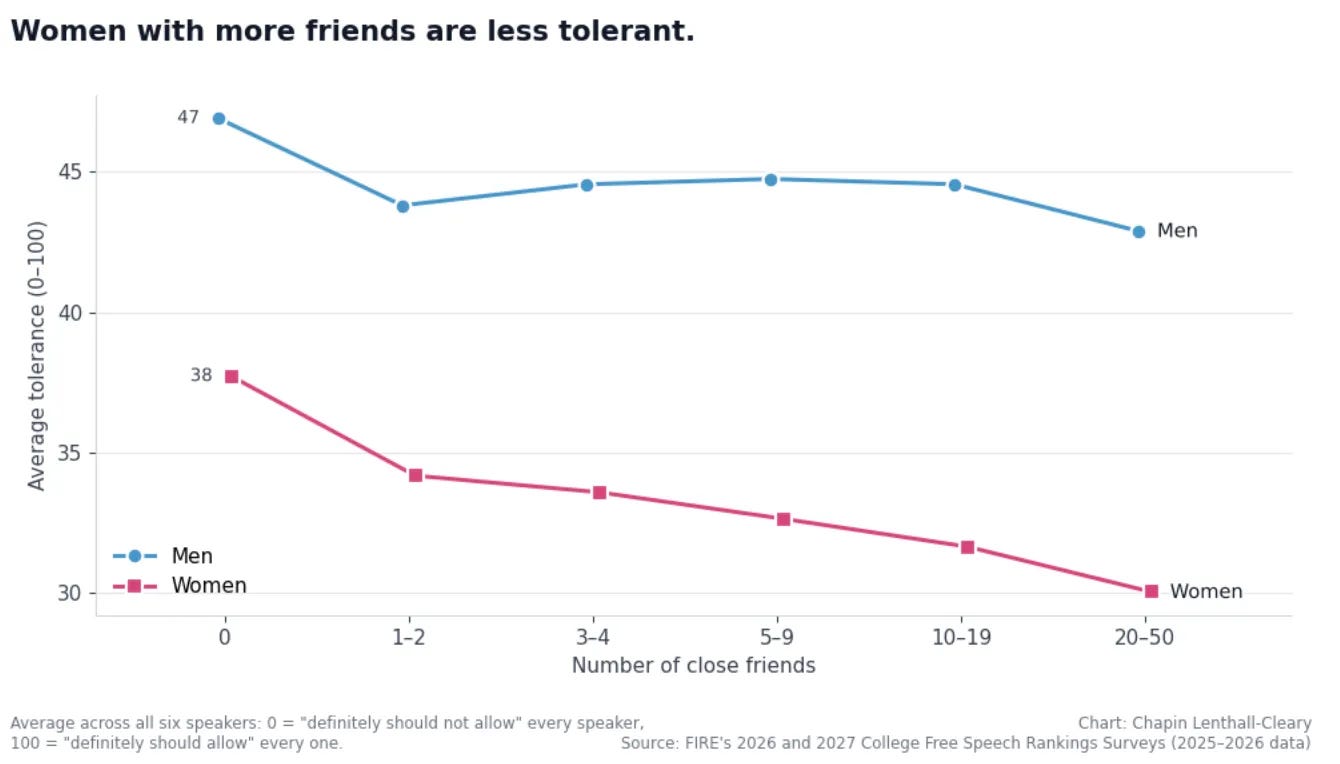
Chapin Lenthall-Cleary analyzes data from roughly 120,000 students surveyed for FIRE’s College Free Speech Rankings and finds that having more close friends may make you less tolerant of controversial speech — especially among women.
This post got me reading Meiklejohn’s work. Great post!