


“I am pleased my First Amendment rights have been vindicated. The people’s freedom to participate in civil discourse is crucial to a healthy democracy. I am looking forward to moving on and spending time with my family.”
— Larry Bushart after winning an $835,000 settlement over his Facebook-post arrest.
Larry Bushart, jailed over Facebook meme, wins $835,000 settlement
Tennessee officials must pay $835,000 to settle a lawsuit filed by retired police officer Larry Bushart, who was jailed for 37 days over a Facebook post he made about the assassination of conservative activist Charlie Kirk.
“It’s in times of turmoil and heightened tensions that our national commitment to free speech is tested the most,” said Cary Davis, an attorney for FIRE, which helped represent Bushart. “When government officials fail that test, the Constitution exists to hold them accountable. Our hope is that Larry’s settlement sends a message to law enforcement across the country: Respect the First Amendment today, or be prepared to pay the price tomorrow.”
Below the fold
After administrators at Cape Fear Community College censored a modern staging of the ancient Greek play The Bacchae, one theater student and former Marine found himself fighting for free speech.
Clemson fired two professors and one staff member over social media posts about Charlie Kirk’s assassination, then two faculty risked their own careers to challenge the growing culture of censorship on campus — winning FIRE’s Berkson Award in the process.
A Nevada high school allegedly praised students for protesting ICE one day, then expelled another student for posting pro-ICE stickers the next, comparing the stickers to a burning cross and prompting a federal lawsuit.
Figures of speech
This year, the United States celebrates its 250th anniversary. To commemorate the occasion, FIRE is proud to present the limited series “Figures of Speech,” looking at the heroes and villains of free speech in American history. This week, we present Thomas Paine — American history’s winter soldier:
On June 8, 1809, 72-year-old Thomas Paine took his last breath inside a small house in Greenwich Village. The next day the pamphleteer and revolutionary’s body was loaded onto a cart and taken to his farm in New Rochelle, about 22 miles north of New York City, for burial. There was no procession, no national moment of silence, no celebration of a life fully lived. Only six people attended his funeral, including his caretaker, Madame Marguerite Bonneville, a friend from his many years in Revolutionary France, and her son, Benjamin. Continue reading…
In the frame
The Big Sea became the week’s standout free-speech media story when this award-winning documentary about pollution, surfing, and Louisiana’s Cancer Alley allegedly had its public screening shut down by parish leadership, turning an environmental film into a censorship fight. St. John the Baptist Parish President Jaclyn Hotard allegedly “vetoed” a public-theater screening of the film, which ties neoprene production to pollution in Reserve, Louisiana. Organizers say no explanation was given 16 weeks later, while a Tulane First Amendment Clinic professor called the cancellation “very clearly a First Amendment violation.”
‘Spirit of Liberty’
On May 21, 1944, Judge Learned Hand delivered a speech in New York City that famously defined the spirit of liberty as “the spirit which is not too sure that it is right.” Read the full speech on FIRE’s website.
This week in history
On May 22, 2000, the Supreme Court ruled in U.S. v. Playboy Entertainment Group that a federal law requiring cable operators to “fully scramble” sexually explicit channels or restrict them to late-night hours violated the First Amendment.
Playboy entertainment challenged the constitutionality of the law, which was intended to prevent children from accidentally viewing adult content. The Supreme Court held that the law, Section 505 of the Communications Decency Act, did not satisfy strict scrutiny because it was not narrowly tailored and because less restrictive alternatives — such as targeted channel blocking at a subscriber’s request — were available to achieve the government’s goal.
By the numbers
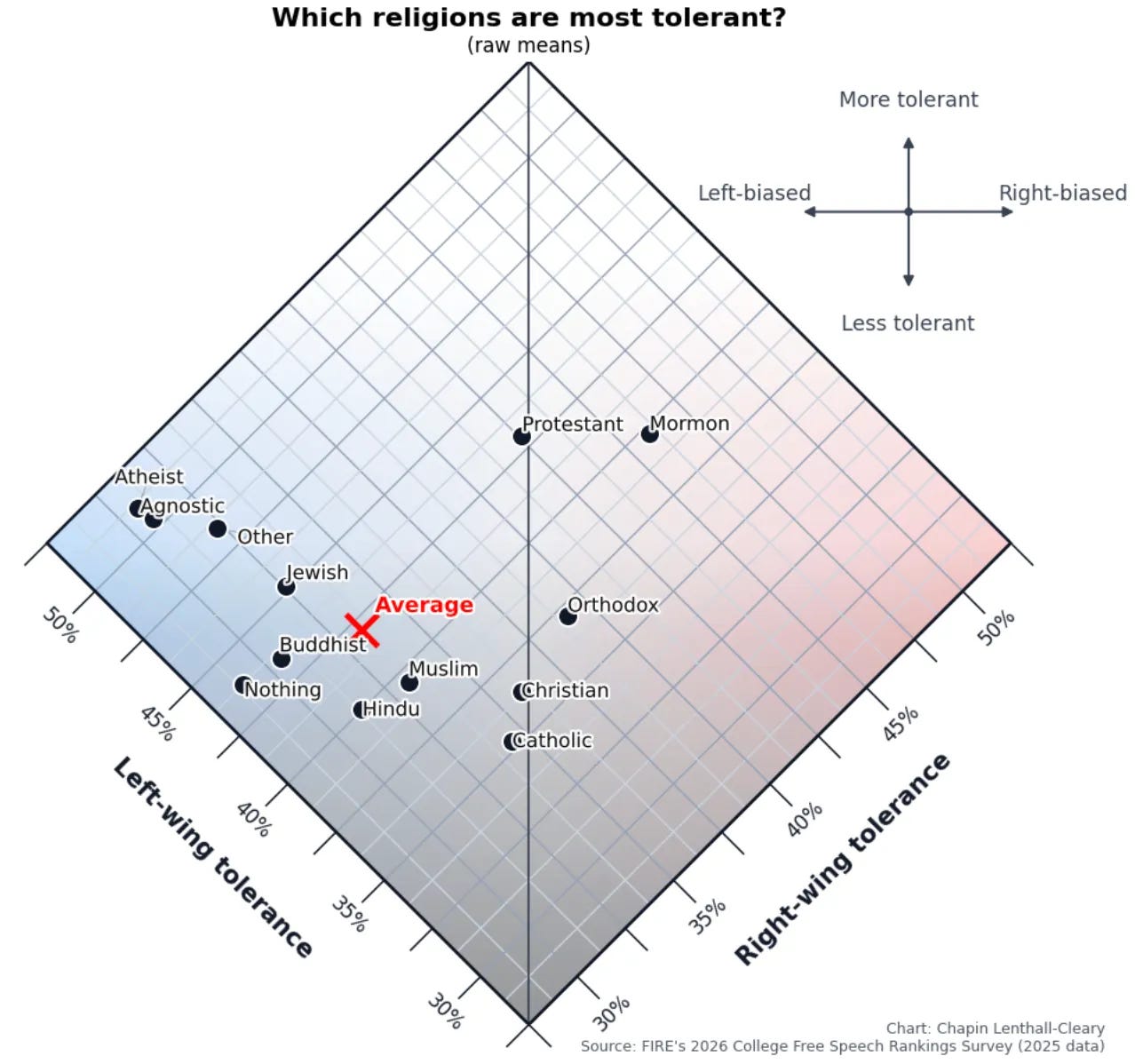
We’ve seen before that students who frequently attend religious services as well as students who are studying religion are unusually tolerant of controversial speakers, meaning they are willing to let them speak on campus. This raises a few questions. Are religious people more tolerant? Which religions’ members tend to be more tolerant? In this week’s data dive, we discuss several findings related to these questions. For example, we found that students who choose to identify as Protestant are the most tolerant religious group on campus. Mormon students are also very tolerant. Atheists and agnostics are especially tolerant of left-wing — but not right-wing — speakers. And Catholic students have the lowest average tolerance.
https://expression.fire.org/p/college-free-speech-faces-a-new-threat
More than 8 months later, and FIRE/Expression has still not amended or retracted the bogus claim, based on dishonest use of statistics, in the still available link above.
See my long (unresponded to) comment in that link for the details behind my claim.
It is wonderful that FIRE is acting as a watchman over threats to free speech from all sides.
The question is, who watches the watchman? And why does the watchman refuse to react or respond when called out?