


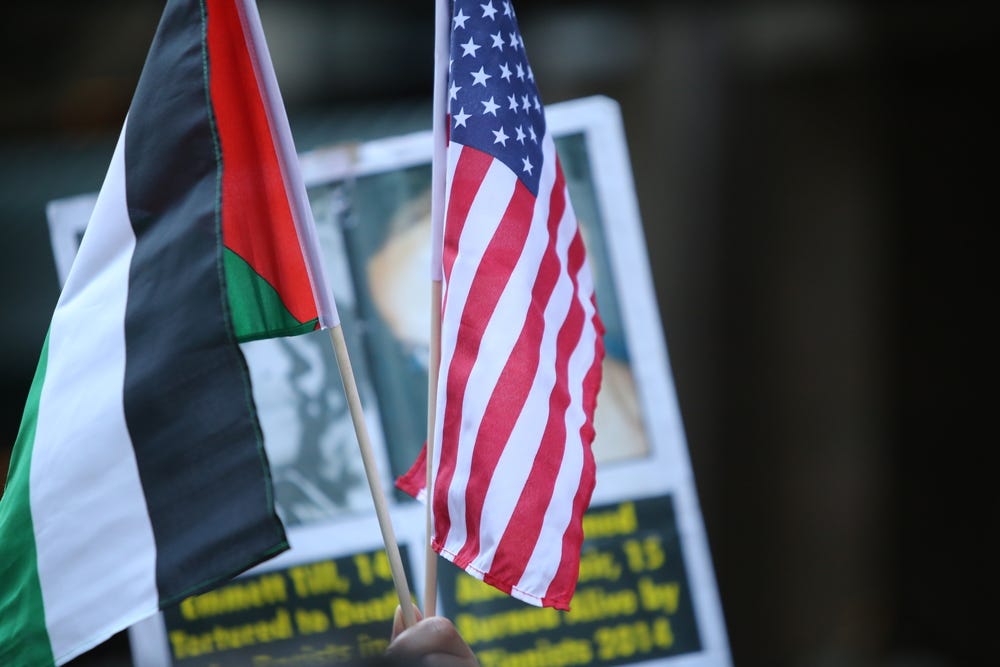
Two of the most visible student groups in the country — Students for Justice in Palestine and Turning Point USA — have next to nothing in common except: both are frequently targeted for their protected speech. Together, they account for 24% of all group entries in FIRE’s Students Under Fire database going back to 2020.
In case you don’t know these two groups, one advocates for Palestinians while the other advocates for conservatives, and they are no strangers to controversy. For example, in February 2026, Israel’s consul general in New York sent a letter to leaders at CUNY School of Law demanding the cancellation of an event organized by the school’s SJP chapter, which described Hamas’ tunnel network as “decolonial land use.” And in February 2021, student groups at the University of Nevada, Las Vegas demanded the derecognition of TPUSA over allegations that the national Turning Point Action “bused domestic terrorists to the Capitol and attacked our democracy.”
But this is not to suggest that the two groups are themselves perfect on free speech. SJP is known to disrupt campus events, such as the 2024 discussion between Bari Weiss and Frank Bruni at UNC Chapel Hill. TPUSA doesn’t really do that, though their national organization does maintain a Professor Watchlist to “expose and document college professors who discriminate against conservative students, promote anti-American values and advance leftist propaganda in the classroom.” Some entries in the watchlist include the contact information for administrators, ostensibly for visitors to file complaints.
Nevertheless, both groups are provocative. And both claim their speech is uniquely under assault. SJP says there is a “Palestine exception,” a pattern of discrimination against those advocating for Palestinians or against Israel. TPUSA says campuses are overrun with intolerant “woke leftists” who want to silence conservative voices. But the data tells a more complex narrative, one in which censorship on each side is real, yet also asymmetric.
Who started it?
Even a cursory glance at the data immediately reveals that censorship efforts against these two groups come from completely different places.
Roughly 75% of censorship efforts against TPUSA come from their fellow students, compared to only 20% against SJP. Students are by far the main censors targeting TPUSA. Administrators do too, to a lesser degree. And they are not really targeted by politicians. By contrast, SJP’s censors strike a closer balance among all three groups, but SJP experiences about seven times as many censorship efforts from politicians as TPUSA.
How are they punished?
Given the sources of these censorship efforts, it’s little surprise that these two groups would end up facing different sets of consequences for their speech. After all, administrators respond with a different range of disciplinary options than student governments.
As it turns out, 51% of all campaigns against SJP result in some sort of administrative punishment, compared to only 29% for TPUSA. But, interestingly, both groups are being punished at lower rates than all other student groups combined.
While SJP faces administrative punishment more often than TPUSA, these dealings are often less consequential. About 32% of administrative punishments against TPUSA result in the denial or loss of recognition. That’s above the average for all other student groups, which is only 10%, and far more than the 7% for SJP.
This pattern is even more pronounced when looking at student governments. Not only do student governments discipline TPUSA far more often than SJP — 26% vs. 2% — but they also deny or revoke TPUSA’s recognition practically every time (92%).
What about admins?
How institutions respond to speech controversies matters, which is why FIRE endorses institutional neutrality, because even well-intentioned statements of such a nature can have a chilling effect. And when it comes to SJP and TPUSA, the data is clear: administrators are far more likely to speak out against SJP than other groups.
When SJP is the target of a speech controversy, administrators issue public statements condemning its expression about a third of the time (30%), or double the rate of all other groups and nearly four times as often as they do in response to speech controversies involving TPUSA (8%). When it comes to actual punishments of these groups, the numbers get even worse: administrators condemn SJP’s expression up to 45% of the time, other groups 21% of the time, and TPUSA only 14% of the time.
On top of that, when TPUSA is the target, roughly 24% of the time administrators put out what we call an “Honor Roll” statement explicitly supporting the students’ expressive rights. In other words, the administrators speak up in the students’ defense. That’s twice as often as they do when other groups face down a censorship campaign, and thrice as often as they do when it’s SJP (8%).
What does it all mean?
As is so often the case when it comes to campus censorship, all sides have good reason to complain. The winds of campus censorship highlighted in last year’s Students Under Fire report have only grown stronger, with 2025 setting records for all the wrong reasons. So how do we slow them down and create a healthier climate for all students?
For starters, administrators can adopt an official position of institutional neutrality and better educate student governments, which must often act as agents of the institution, on the importance of freedom of speech. Student governments can likewise adopt neutral positions, recognizing that when they deny certain groups status or access to resources, they only deepen conflict and fuel resentment.
We live in divided times. If students are discouraged or prohibited from even talking across differences, that divide will not just persist, it will grow, and for the worst possible reason: not because they simply come to different conclusions on important issues, but because they don’t even know or understand what their opponents think.
