“We’re proud to join the revolutionary struggle that is core to our country’s founding and all humanity’s dignity. It remains revolutionary two and a half centuries later, and will undoubtedly stay revolutionary forever.”
— Angel Eduardo, “250 years later, free speech is still revolutionary”
KIDS Act will let Washington dictate how we talk online
Its supporters say the KIDS Act is about protecting children online, but Carolyn Iodice and John Coleman argue it would actually hand the government sweeping new power over how Americans communicate — reshaping social media, chatbots, and other online platforms in ways that violate the First Amendment and threaten free speech.
Child safety is an important goal. But it can never become a license for the government to dictate how Americans speak, read, and communicate online.
How a Leninist principle is reshaping faculty politics
Educational institutions are increasingly adopting so-called One Voice policies that require governing board members to publicly support board decisions — and sometimes prohibit them from criticizing the board, speaking to the press, or even posting independently on social media.
Drawing on examples from across the country and several ongoing lawsuits, John R Ellis makes the case that institutions dedicated to teaching civic values should encourage dissent, not silence it. Besides, he adds, “Suppressing dissent over critical decisions doesn’t make the dissenters go away — it makes them madder and more determined.”
Below the fold
German lawmakers want to narrow a law that protects politicians from insults, journalists say they were removed from a U.S. Embassy Fourth of July event in Brussels after questioning Ambassador Bill White, and Canada has a new hate crime law. For this and more, see Sarah McLaughlin’s latest Free Speech Dispatch.
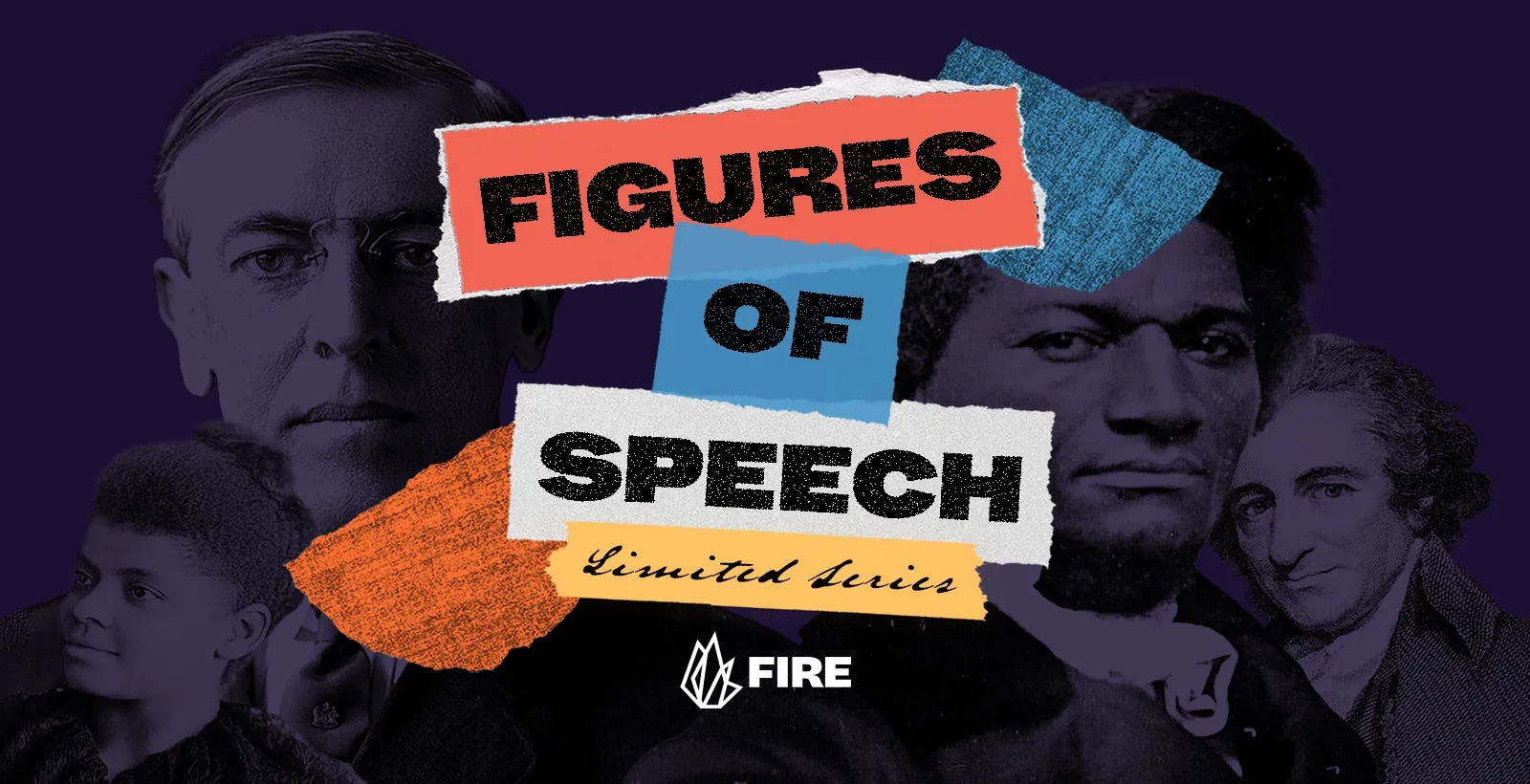
This year, the United States celebrates its 250th anniversary. To commemorate the occasion, FIRE is proud to present the limited series “Figures of Speech,” looking at the heroes and villains of free speech in American history. We began with Joseph McCarthy, the senator who scared America silent. Then we looked at Thomas Paine, American history’s winter soldier, and Woodrow Wilson, our worst president for free speech. Today we turn to Frederick Douglass, whose legacy represents the very best of what it means to be American.
In 1860, Frederick Douglass watched a violent pro-slavery mob storm the stage at the Tremont Temple Baptist Church in Boston before he could even begin speaking. Abraham Lincoln had just been elected to the presidency the month before on the promise to halt slavery’s expansion westward. In response, rumors spread from below the Mason-Dixon that South Carolina was convening to discuss secession. Other states were making similar calls to delegates. War was looming. The nation was a powder keg. Continue reading...
Terms of service
Artificial intelligence is reshaping how we create, communicate, and access information — and lawmakers are rushing to control it. So what role should a free speech organization play in all this? Tyler Tone takes readers inside FIRE’s growing work on AI, from state legislatures and federal courts to research and grantmaking.
Also, Anthropic dropped its latest model yesterday — Fable 5 — which it had previously released before pulling it off the shelves, so to speak, in order to make some adjustments to please the federal government. Not good, folks:


In the frame
Citizen Vigilante is a thriller directed by Uwe Boll and starring blacklisted actor Armie Hammer as an American living in Europe who takes justice into his own hands and embarks on a campaign of extrajudicial violence against corrupt officials, violent youth, and a Muslim rape gang — as well as one of the rapist’s entire family. Critics have called the film xenophobic, while Boll says it’s a critique of government failures and actual crimes, rather than an attack on migrants as a whole. Germany’s film ratings board (FSK) refused to classify the movie, saying it could incite violence against migrants, which means the film cannot be widely screened or advertised in Germany, and is effectively banned. Elon Musk posted the entire film on X for 48 hours, turning a niche release into an international debate over censorship. Boll says he’s suing the FSK, calling their decision “against the constitution.”
So to Speak
So to Speak: The Free Speech Podcast takes an uncensored look at the world of free expression through the law, philosophy, and stories that define your right to free speech. Hosted by FIRE’s Nico Perrino.
Book bans may dominate today’s headlines, but the fight over what belongs on school library shelves is nothing new. In this episode, Anthony Aycock, author of Just Plain Filthy, revisits Island Trees School District v. Pico — the Supreme Court’s only school library book-removal case—and explains how a decades-old dispute continues to shape today’s battles over free speech and censorship.
Blessings of Liberty
Bestselling author and constitutional scholar Jeffrey Rosen’s new podcast, The Blessings of Liberty, explores constitutional history, Supreme Court debates, and the “American Idea.”
In this special episode of The Blessings of Liberty, a celebration of America’s 250th anniversary, award-winning filmmaker Ken Burns walks through the Declaration of Independence, clause by clause, to encapsulate the big ideas at the heart of the American story. Jeffrey Rosen, senior fellow at FIRE and CEO Emeritus of the National Constitution Center, moderates.

This week in history with Sophia McKean
As fears of war with France mounted in the summer of 1798, Congress passed the Alien and Sedition Acts, a series of laws that dramatically expanded federal power in the name of national security. Supporters in President John Adams’ administration argued the country needed stronger national security and tighter control over “dangerous” speech. But one part of the law, the Sedition Act, went much further.
The law made it a crime to publish “false, scandalous, and malicious writing” against the government or the president. In practice, that meant journalists, newspaper editors, and political critics could be fined or jailed for speaking out against those in power.
The impact on free speech was immediate and chilling. Several newspaper editors were prosecuted, and political criticism of the federal government became risky at a moment when public debate was still shaping what the young republic would become.
Opponents, including Thomas Jefferson, argued the laws violated the First Amendment and turned political disagreement into a punishable offense. The controversy helped fuel one of the nation’s earliest debates over whether the government itself could decide what counted as “acceptable” speech. Even after the laws expired or were repealed, the episode became a lasting example of how quickly free expression can come under pressure in moments of political fear.
This month in history with Sheridan Macy
Can the government punish people for organizing a boycott? On July 2, 1982, the Supreme Court answered with a resounding no. In NAACP v. Claiborne Hardware Co., the Court held that a civil rights boycott of white-owned businesses in Mississippi was protected by the First Amendment. Even though some participants had engaged in threats or intimidation, the Court ruled that those actions did not erase the constitutional protection for the boycott itself. The decision cemented peaceful political boycotts as one of the First Amendment’s most powerful forms of collective expression.
By the numbers
In this week’s data dive, Chapin Lenthall-Cleary dives into one of the stranger corners of FIRE’s campus free speech survey: the students who skipped conventional religious labels in favor of answers like “Disciple of Cthulhu,” “Pastafarian,” and “Baseball Gods.” With tongue firmly in cheek, he explores whether these unconventional respondents differed in their willingness to allow controversial speakers on campus, uncovering some surprisingly suggestive patterns about tolerance, thoughtfulness, and the kinds of people who take the time to give unconventional answers, ultimately answering the question, “how tolerant are disciples of Cthulhu?”