


Free Speech Dispatch covers censorship trends and challenges around the world. If you want to know where free expression is under attack and why it matters, subscribe now to get each edition delivered to your inbox.
Few international free speech stories have received as much attention in recent months as the United Kingdom’s descent into a censorial spiral, as I’ve regularly covered here at the Free Speech Dispatch. Police show up at the doors of social media users — even teens — to question them over jokes, pseudo-blasphemy arrests are on the table, and officials are now warning that the under-16 social media ban may require adults to show their passports to post. And that won’t even be the end of the growing battle against online “harm.”
But amidst these other censorship battles, another one with high stakes has been brewing for years: Thousands of Britons are facing terror charges for nothing more than holding signs.
UK’s censorship of Palestine Action keeps ballooning
Sixteen months ago, the UK banned activist group Palestine Action, some members of which have been convicted of criminal conduct including vandalism of military planes and assault of a police officer during a break-in at an Israeli defense firm. (Vandalism and assault are, of course, not protected expression.) The group is currently challenging its proscription at the UK’s Supreme Court, and the court’s ruling could leave a substantial imprint on free expression in the UK.
What’s important to understand about the proscription of Palestine Action, though, is that the Terrorism Act 2000, under which authorities banned the group, targets much more than just conduct. The law bans expressing “support” for banned groups and threatens long prison terms for violations — and in this context, “support” doesn’t mean providing weapons or materials to the banned group but simply voicing approval of it (or maybe even just opposing the ban).

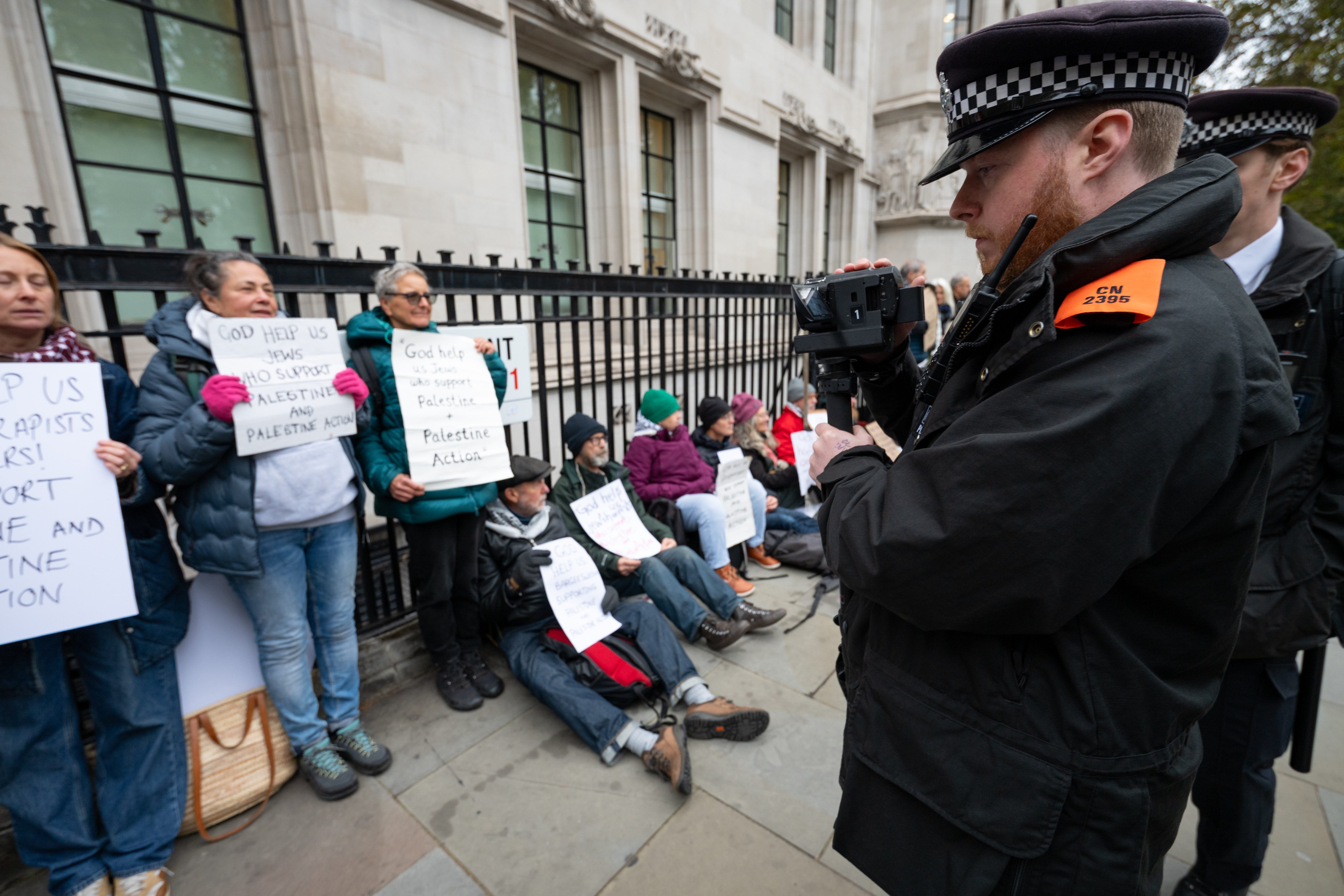
On Halloween, 325 people were arrested after peacefully holding signs reading “I oppose genocide, I support Palestine Action” outside the American embassy in London. (The United States recently imposed terrorism-related sanctions on Palestine Action.) Those arrested could face terrorism charges, simply for holding signs in public. More than two dozen protesters joined them, arrested for a similar demonstration outside the Supreme Court as the legal challenge began. But they won’t be alone — more than 4,000 arrests have been made under the Terrorism Act 2000 for holding such signs. As London’s Metropolitan Police warned last summer, “It will take time but we will arrest anyone expressing support for Palestine Action.”
But the questions of censorship extend beyond whether the UK will continue to brand thousands of people as terror offenders for peacefully protesting. Andreas Malm, a professor at Sweden’s Lund University and author of the provocatively titled climate activism book How to Blow Up a Pipeline, learned late last month that immigration officials would not permit him entry to the UK because his presence would not be “conducive to the public good.” (He joins other barred figures like left-wing streamer Hasan Piker and Christian conservative Finnish lawmaker Päivi Räsänen.) Malm had planned to join Palestine Action co-founder Huda Ammori to discuss the legal challenge against the ban as well as novelist Sally Rooney’s publisher refusing to sell her books in the UK due to her support of the group.
Severe sentences for government critics in Hong Kong, Macau, Thailand
Joshua Wong, one of Hong Kong’s most prominent democracy campaigners, started out on his activism journey as a teen. That same activism will now keep Wong, already behind bars on national security charges, in prison until he is 40 years old. Last week, Wong was sentenced to a decade under the city’s oppressive national security legislation for “conspiracy to collude with foreign forces to endanger national security.” It’s a shocking punishment for one of Hong Kong’s most notable protest figures, and one that reflects Beijing’s growing stranglehold on the city. In another one of China’s special administrative regions, Macau, former lawmaker Au Kam San received a similarly alarming punishment, also in a national security case. In a closed-door trial, Au was sentenced to 12.5 years in prison for “collecting and disseminating political views laden with ideas of subverting state power and false information” and conspiring to “incite hatred among Macao residents against the central government.”
And in Thailand, human rights lawyer Arnon Nampa received another guilty verdict in one of the dozen-plus cases against him for violating the country’s lese-majeste law, which criminalizes insults and criticism of the monarchy. This time, it was for attending a Bangkok protest in 2020 while dressed as Harry Potter. In his combined cases, Nampa has been sentenced to over 34 years in prison, and two cases are still pending. His partner brought their three-year-old son to see Nampa, still shackled, at his sentencing.
Georgian journalist keeps getting jailed for ‘dicks’ diss
As I reported this summer, Georgia (the country, not the state) is cracking down on insults to politicians, both through recent revisions to the criminal code and a new “Division for Combating Hate Speech.” Talking a little trash about Georgian legislators may very well land you in court. Such has been the case for journalist Vakho Sanaia, first fined around $2,300 in July for a sarcastic Facebook post encouraging people not to call two Georgian Dream politicians “dicks.” After he joked that the fine meant you should call those politicians dicks, the new hate speech task force investigated him, leading to a 14-day sentence for his “willingness to continue engaging in unlawful conduct.”
When America knew what it was defending

I recently took my son to Poster House in New York City, a wonderful little museum in Chelsea devoted to the history and power of posters. I actually collect vintage travel posters, so I have been visiting for quite some time. Usually, the museum is cheerful and a bit political, so I didn’t expect to le…
Sanaia has now been sentenced again for — you guessed it — more “dick” remarks. Shortly before he began his two-week sentence this summer, Sanaia joked that no one should call the politicians dicks for 14 days because “When I get out, I’ll take care of that matter myself.” Sanaia was then convicted again last month, and will serve 30 more days.
New restrictions on teens’ social media use:
Mexican President Claudia Sheinbaum approved a decree banning platforms from allowing teens under 18 to see material that “generates or promotes” behavior including hate speech, suicide, deliberate self-harm, eating disorders, cyberbullying and sexually explicit material.
Greece’s parliament passed its under-15 social media ban last month, giving social media platforms until the new year to “determine whether the accounts they host and the services they provide are intended for adults or not.” It goes into effect January 1.
Australia’s landmark under-16 social media ban receives a lot of attention — both from proponents who thus far have quite successfully encouraged other nations to follow suit, and from civil liberties advocates concerned about the speech and privacy implications of these bans. Though the ban approaches its first full year in effect, legal action around it continues. Both Reddit and the Digital Freedom Project argued their case in the Australian high court last week, with Reddit calling the ban “ill-thought-out, over-broad legislation.”
Writer CJ Hopkins fined over tweets despite initial acquittal
At FIRE, we’ve covered in-depth the case(s) of CJ Hopkins, an American writer living in Germany and facing multiple prosecutions stemming from his book, The Rise of the New Normal Reich: Consent Factory Essays, Vol. III (2020-2021), and its cover showing a swastika and medical mask. Hopkins was initially acquitted for violating Germany’s law against disseminating propaganda in tweets showing the book’s artwork, but the prosecutor appealed the verdict over the summer, and last month Hopkins received his sentence: a €4,800 fine. Hopkins is also awaiting news in the separate charges he faces over “authoring, publishing, and advertising” the same book.
EU border police seek new social media powers
European lawmakers and activists are raising objections over the European Commission’s proposal to give border police Frontex new authorities to monitor social media for posts encouraging illegal border crossings. The proposal would allow Frontex to “set up an internal structure to monitor social media and report to the platform in question the content it says is facilitating illegal entry to EU countries.” The border police would therefore serve as trusted flaggers under the EU’s controversial Digital Services Act, giving it heightened authority and status to flag content for review. Italian lawmaker Brando Benifei criticized the measure, saying the Commission “now proposes copying ICE’s invasive online tracking,”
Brutal blasphemy punishments in Iran, Pakistan
An Iranian court sentenced 23-year-old Najmeh Amini to death last month. Her crime? “Insulting the prophet” in a social media post, one which caught the eye of Iran’s Cyber Police. Amini told the court that she made the post without intending to blaspheme and after taking hallucinogenic mushrooms. “Why, in that same hallucinatory state, did you not insult other individuals or opponents of the regime, such as America and Israel?,” the presiding judge asked.
A Pakistani court sentenced four men to death for sharing “content derogatory to the Holy Quran and Islamic sacred personages” on Facebook and WhatsApp.
Separately, Pakistan’s Supreme Court overturned the 2006 death sentences handed out to two brothers for blasphemy, citing their bipolar disorder diagnoses. Both brothers have already spent two decades behind bars on the charges.
Feby Indirani, author of Memburu Muhammad (Hunting for Muhammad), was scheduled to speak at Bogor Literary Week in Indonesia this fall. Instead, the Islamic Brotherhood Front pressured the organizers to disinvite her. And then Indonesian police stepped in — not to protect Indirani against threats, but to investigate her for the book’s “sensitive material” that could “offend the beliefs of religious people.”
Financial crimes prosecution as a form of press censorship
Azerbaijani prosecutors are seeking whopping dozen-year long sentences against journalists and a staffer at independent media outlet Meclis.info for financial crimes, which advocates say are being used to punish independent reporting. And perennially repressive Turkey is continuing its crackdown on the press, with a recent raid on broadcaster Halk TV. Prosecutors say they are investigating the station’s chairman for bribery and money laundering allegations, and authorities instituted a “trustee manager” to oversee the outlet.
