



The FIREwire is a weekly news roundup of the biggest stories involving free speech, as well as reports, essays, fresh data, and original analysis.
“Censorship is not a remedy for tragedy.”
— Sarah McLaughlin, on the campaign for Arday’s Law, which proposes limiting the number of articles that can be published about a person within a given timeframe.
First things first
Free speech had a funny week. Almost every story below begins with a reasonable-sounding impulse — protect Jewish students from antisemitism, protect Christian worshippers from disruption, protect black professors from racism, protect young people from social media. But the trouble begins one step later, when someone proposes giving an institution the power to decide which speech has become too dangerous, too offensive, too disruptive, or simply too politically inconvenient.
The best defense of free expression is not that every speaker is virtuous or every idea wise, but that power is dangerous whenever it can control who gets to speak, how often, or under what conditions. This week’s stories are variations on that theme.
FIRE’s GUARD Act protects professors
Professors need more than rights they can vindicate only after years of litigation, so FIRE has drafted the GUARD Act to put those protections directly into state law.

The proposal responds to an increasingly awkward reality. FIRE recently recorded a massive spike in the number of incidents involving politicians trying to silence faculty, while the old threats of administrative censorship remain. The GUARD Act would protect faculty as well as universities, which cannot plausibly promise intellectual freedom while treating controversy itself as evidence of misconduct.
Speech codes won’t end antisemitism
Students who disrupt invited speakers are interfering with expression, but as Max Friedman argues in part three of his series on antisemitism, universities shouldn’t respond by adopting viewpoint-discriminatory speech codes. Focusing on several incidents involving pro-Israel speakers, Friedman explains that students have no First Amendment right to seize control of an event simply because the speaker’s views are offensive or unpopular. But, he adds, if schools incorporate the IHRA’s vague and politically loaded definition of “antisemitism” into campus harassment policies, this just ends up creating yet another kind of censorship.
“Rather than responding to illiberalism with more illiberalism,” says Friedman, “universities and state actors should adopt policies that empower and protect the right to boldly speak back.”
Below the fold


International
The death of Cambridge professor Jason Arday has triggered grief, anger, scrutiny of the press, and a political campaign for new government limits on reporting. Sarah McLaughlin’s argument is brutally simple: People can condemn what they see as cruel or irresponsible journalism without resorting to prior restraint. Her essay also carries an important warning for American readers, because the First Amendment’s protection of press freedom is not merely a celebration of the importance of journalistic work. It’s a rejection of the idea that any government should ever become the editor of the public record. As she puts it:
Arday’s Law, or similar restrictions on press freedom, will not end cruelty or public speculation. They might, though, just give the powerful yet another tool to shut down much-needed inquiry into their conduct or even their crimes.
Also this week, McLaughlin reports that foreign journalists will soon face social-media vetting to obtain U.S. visas. This message is clear: Be careful what you say about the United States if you want to come here. McLaughlin places this alongside a striking international roundup, from Singapore barring Massive Attack after a pro-Palestinian show to Russia reportedly blacking out passages about LGBT people in Pope Francis’ memoir. If there’s a pattern, it seems to be that restrictions introduced for one supposedly exceptional category tend to become precedents for the next.
Media
A Reconstruction-era law designed to crush the Klan, and tested against the Mafia, is now being used to prosecute Douglass Mackey over a meme and Don Lemon over his coverage of an anti-ICE protest at a church. Adam Goldstein’s history lesson takes us through the meaning of “conspiracy” itself, the evolution of Section 241, a few wild passages of Klan and Mob history, and skillfully pulls it all together to make the larger point that a law can have an admirable origin, but still become dangerous if prosecutors stop treating its limiting words as limiting words.
Also in media news, Disney is suing the FCC and Bob Corn-Revere, chief counsel at FIRE and former chief counsel to FCC Chair James Quello, appeared on The Lead with Jake Tapper to discuss. When Tapper asked why The View, which is produced by Disney-owned ABC News, cannot book political figures, Corn-Revere replied, “Well, they can, but they’re taking the risk of further action by the FCC. When the FCC announced it was going after The View, it was because of the fact that they were booking political candidates for news interviews. Except programs like The View historically have been treated as exempt from the equal opportunities rule.”
In January, the FCC issued a public notice warning TV broadcasters that talk shows are not exempt from the rule, which says that if a broadcast station gives one political candidate airtime, it has to give that candidate’s opponents an equal time. Corn-Revere added that Congress amended the Communications Act in 1959 to create an exemption for bona fide news interviews. He said the FCC has been trying to reinterpret the law to deny that exemption to The View, as President Trump and Chairman Carr have criticized the ABC program.
Podcasts
The Blessings of Liberty explores constitutional history, Supreme Court debates, and the “American Idea,” hosted by bestselling author and constitutional scholar Jeffrey Rosen.
In this episode, law professor Robert P. George joins to discuss the philosophical underpinnings of the American Founding, the original meaning of “the pursuit of happiness,” the centrality of education to the formation of virtue, and the importance of structural safeguards for the protection of liberty.
So to Speak takes an uncensored look at the world of free expression through the law, philosophy, and stories that define free speech — hosted by FIRE’s Nico Perrino.
This month’s member webinar tackled a grab bag of First Amendment questions, from a Washington journalist facing a campaign-finance investigation to the Supreme Court’s recent conversion-therapy decision, the FCC’s pressure campaign against Disney and ABC, and FIRE’s fight for noncitizens’ speech rights. The conversation repeatedly returned to one theme — governments cannot evade the First Amendment by relabeling speech as conduct, whether they are regulating therapy, journalism, entertainment, or academic debate.
Today in history with Sheridan Macy
On Aug. 17, 1979, Monty Python’s Life of Brian, an outrageous parody of biblical times that is widely regarded as one of the greatest comedy films of all time, opened in the United States. The movie tells the story of Brian Cohen, who is born on the same day as, and next door to, Jesus, leading to his being mistaken for the messiah. Because of its controversial subject matter, the movie’s financing was pulled at the last minute by EMI Films, leading former Beatle George Harrison and his business partner Denis O’Brien to provide financing.
The film was generally well received by critics, who found it hilarious but recognized its potential to offend with its coarse language and religious satire. In Britain, the BBC and ITV declined to show it for fear of offending Christians. Protests and censorship efforts followed: rabbis and nuns picketed screenings in New York, while South Carolina Sen. Strom Thurmond demanded the distributor withdraw it, generating even more publicity. Other evangelical figures called for the cast to be prosecuted for blasphemy. The film was banned or suppressed in several U.S. states and towns, including Shreveport, Alabama, Alexandria, Louisiana, and Georgia, which cited its “lewd exhibition of genitals.” It was also banned for a year in Norway and eight years in Ireland.
Originally, the film was planned to open on 200 U.S. screens, but after religious groups’ protests, that number tripled. Swedish theaters advertised the film as “so funny it was banned in Norway.”
By the numbers
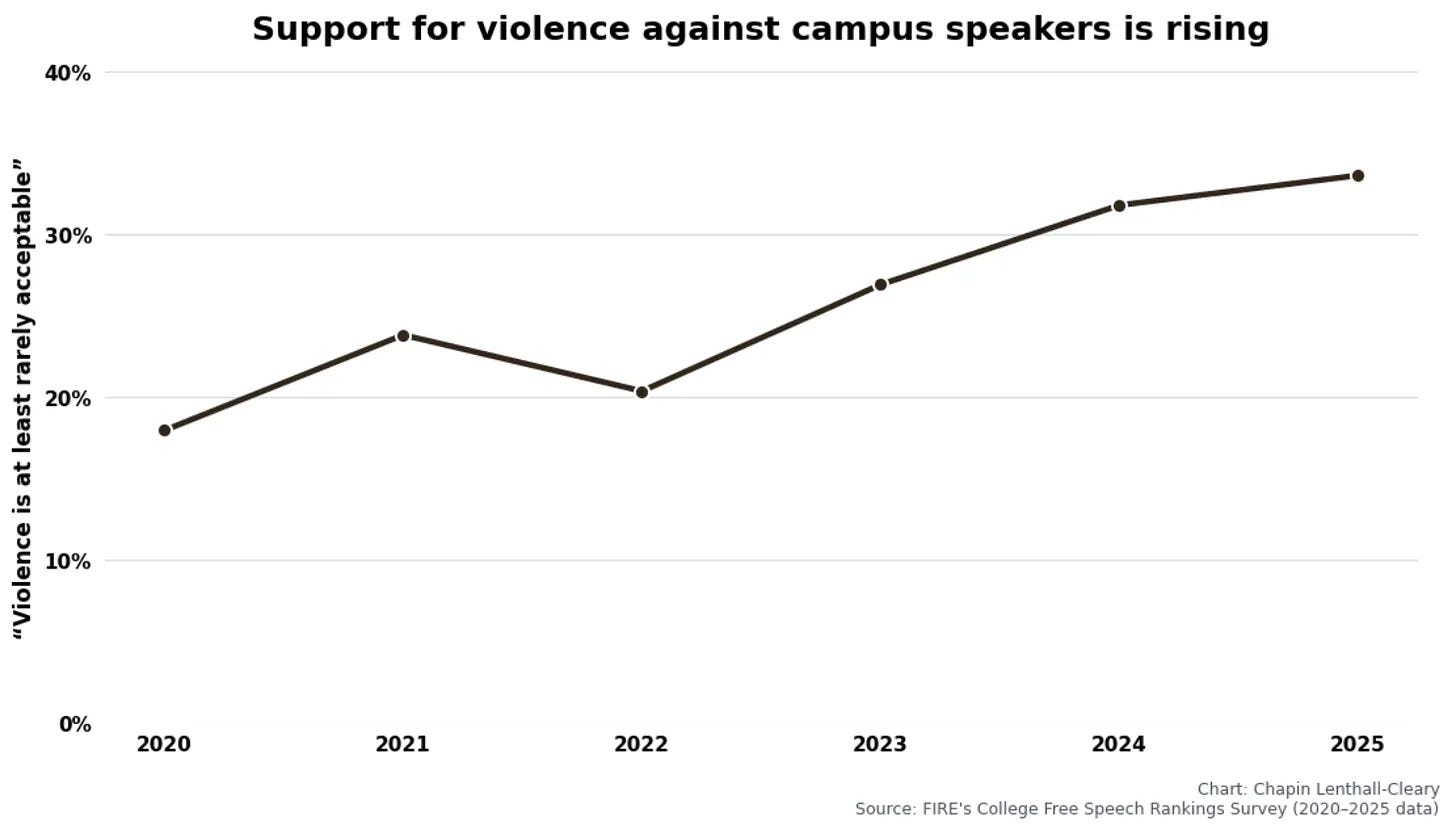
As the poet Paul Valéry once said, “The future is not what it used to be.” Chapin Lenthall-Cleary’s latest data dive asks readers to predict where campus speech culture is heading. Using FIRE’s College Free Speech Rankings data through 2025, he marks the trend lines — and they’re not particularly cheerful. Over the past five years, students who say violence against speakers is ever acceptable went from 18% to 34%.
We would be wise to recall lessons from the founding generations (including those who wrote or ratified our Constitution and Bill of Rights). They did not trust people with power. They did not trust even each other. As Jefferson shows, many knew better than to trust even themselves. See https://founders.archives.gov/documents/Jefferson/01-11-02-0047
The truth about people in power is that "under pretence of governing" many public officials "have divided" people "into two classes, wolves and sheep. I do not exaggerate. This is a true picture[, for example,] of Europe. Cherish therefore the spirit of our people, and keep alive their attention. Do not be too severe upon their errors, but reclaim them by enlightening them. If once [the people] become inattentive to the public affairs, you and I, and Congress, and Assemblies, judges and governors shall all become wolves. It seems to be the law of our general nature, in spite of individual exceptions; and experience declares that man is the only animal which devours his own kind, for I can apply no milder term to [some so-called] governments [ ], and to the general prey of the rich on the poor."
That is why, Jefferson emphasized, the First Amendment expressly secures "the freedom of speech" and "press." That freedom (flowing from the sovereignty of the people) necessarily includes the power to vote and to criticize any public servant's public service.
"The people are the only censors of their governors: and even their errors will tend to keep [public servants] to the true principles of their institution. To punish these errors too severely would be to suppress the only safeguard of the public liberty. The way to prevent these irregular interpositions of the people is to give them full information of their affairs thro' the channel of the public papers, and to contrive that those papers should penetrate the whole mass of the people."
The most important principle in our Constitution and in state constitutions is that "[t]he basis of our governments" is "the opinion" (consent (i.e., speech, including votes)) "of the people," so "the very first object" all public servants "should be to keep that right; and were it left to me to decide whether we should have a government without newspapers, or newspapers without a government, I should not hesitate a moment to prefer the latter."